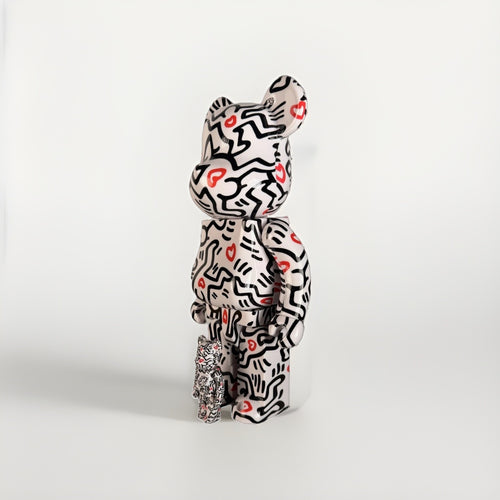
Which BE@RBRICK size holds value best? Based on Gauntlet Gallery's comparable sales data across 160,000+ authenticated transactions, the 400% size (28cm) delivers the strongest secondary-market liquidity — fastest sales, tightest bid-ask spreads, and the deepest buyer pool. 1000% pieces command higher absolute prices but trade less frequently. For most collectors, 400% is the investment standard.
The BE@RBRICK Size Hierarchy: What Each Format Means
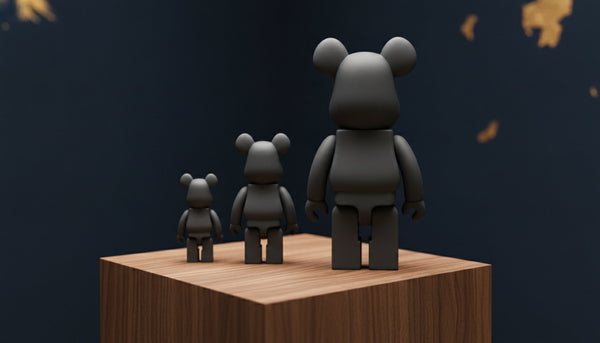
BE@RBRICK was first introduced by Medicom Toy of Tokyo on May 27, 2001, at the 12th World Character Convention. Since then, Medicom has standardized the figures into a percentage-based size system that directly determines liquidity, pricing, and investment behavior on the secondary market.
Understanding how each size functions as an asset class is essential before allocating capital. Gauntlet Gallery, founded in 2012, has tracked BE@RBRICK secondary pricing since the early KAWS collaboration era — and the patterns are remarkably consistent across collaborations.
BE@RBRICK Size Reference Table
| Size | Height | Format | Liquidity Profile |
|---|---|---|---|
| 100% | 7cm | Blind box / Series | High volume, low per-unit price; rare pulls appreciate |
| 400% | 28cm | Standard collector format | Deepest buyer pool, fastest sales, tightest spreads |
| 1000% | 70cm | Statement / Trophy | Highest absolute price, fewer buyers, longer hold times |
| 400% + 1000% Set | Pair | Matched release set | Strongest premium when sold together (set bonus) |
Why 400% Is the Investment Standard
Across Gauntlet Gallery's BE@RBRICK transaction database, the 400% size consistently delivers the best risk-adjusted returns for collectors entering or rotating positions. Three structural reasons drive this:
1. Deepest Buyer Pool
The 400% figure occupies a price band — typically $300 to $5,000 depending on collaboration — that includes serious collectors, gift buyers, interior designers, and crossover art buyers. At 28cm, it displays beautifully on a shelf without dominating a room. This breadth of demand means a 400% listing rarely sits without inquiries.
2. Tightest Bid-Ask Spreads
Because the 400% trades so frequently, comparable sales data is dense and current. Sellers know what their piece is worth within a narrow range, and buyers can verify pricing easily. The spread between asking and selling prices is typically 5–10% — far tighter than the 15–25% spread common on 1000% pieces, where each transaction is more idiosyncratic.
3. Fastest Time to Sale
For authenticated 400% pieces from in-demand collaborations — KAWS, Daniel Arsham, Stash, Futura, Andy Warhol Foundation releases — Gauntlet Gallery typically clears sales in days to weeks. 1000% pieces of the same collaboration can sit for months waiting for the right trophy buyer.
When 1000% Makes Sense as an Investment
The 1000% (70cm) is a different asset class. At nearly two and a half feet tall, it functions more like a sculpture than a collectible. Auction houses including Phillips, Sotheby's, and Heritage now regularly feature flagship 1000% BE@RBRICK pieces in contemporary art sales.
The 1000% wins on absolute price ceiling. A KAWS Companion 1000% or a major Daniel Arsham collaboration can clear $20,000–$200,000+ at auction. But you trade liquidity for that upside — fewer than 5% of collectors transact at that level, and the buyer pool is global rather than local.
For collectors with a 5+ year horizon, conviction in a specific collaboration, and the storage and display space to handle a 70cm figure, the 1000% can outperform on absolute returns. For everyone else, 400% is the smarter capital allocation.
The 400% + 1000% Set Premium
One of the most consistent patterns in Gauntlet Gallery's comparable sales data: matched 400% + 1000% sets command a measurable premium over the sum of their parts. Collectors prize the visual symmetry of displaying the same design at two scales, and breaking up a matched set is widely considered a value-destroying move.
When acquiring or selling, treat 400% + 1000% sets as a single asset. The set premium typically runs 10–20% above combined individual values for sought-after collaborations.
100% Blind Box: Lottery Tickets, Not Investments
The 100% (7cm) format ships in blind box series — buyers do not know which design is inside until opening. Most pulls are common and trade for $20–$50, but rare chase figures and "secret" variants can appreciate to $500–$3,000+.
Treat 100% blind boxes as entertainment, not an investment thesis. The expected value of a single box is negative once you factor in retail markup. The exception: completed full series sets or sealed cases of a sought-after release can hold value over time.
Authentication and the Counterfeit Problem
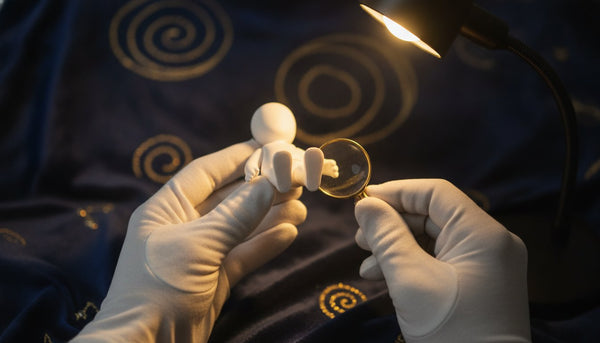
BE@RBRICK counterfeits are widespread — rates exceed 45–60% on open resale marketplaces. The defenses are physical: Medicom's hologram sticker, the molded copyright markings on the figure, packaging build quality, and the documented release record. Checked together, they are hard to fake convincingly.
Authentication also relies on packaging analysis, paint quality, joint articulation, and provenance chain. Gauntlet Gallery authenticates every BE@RBRICK before listing, and our category contract for BE@RBRICK includes hologram, markings, and release-record verification on every piece.
For a deeper dive into authentication chains, sizes, and the full BE@RBRICK market structure, see our BE@RBRICK Complete Guide.
Bottom Line: What to Buy
- First BE@RBRICK or fast liquidity needed: 400% from a major collaboration with a verified authentication chain.
- Trophy piece for a 5+ year hold: 1000% from a flagship KAWS, Arsham, or Warhol release.
- Maximum upside on a single collaboration: matched 400% + 1000% set.
- Entertainment buying: 100% blind box series, with no expectation of return.
Explore authenticated BE@RBRICK inventory and current market pricing in our full collection. Every piece ships with Gauntlet Gallery's category authentication chain: hologram and markings verification, release-record cross-reference, and full provenance documentation.