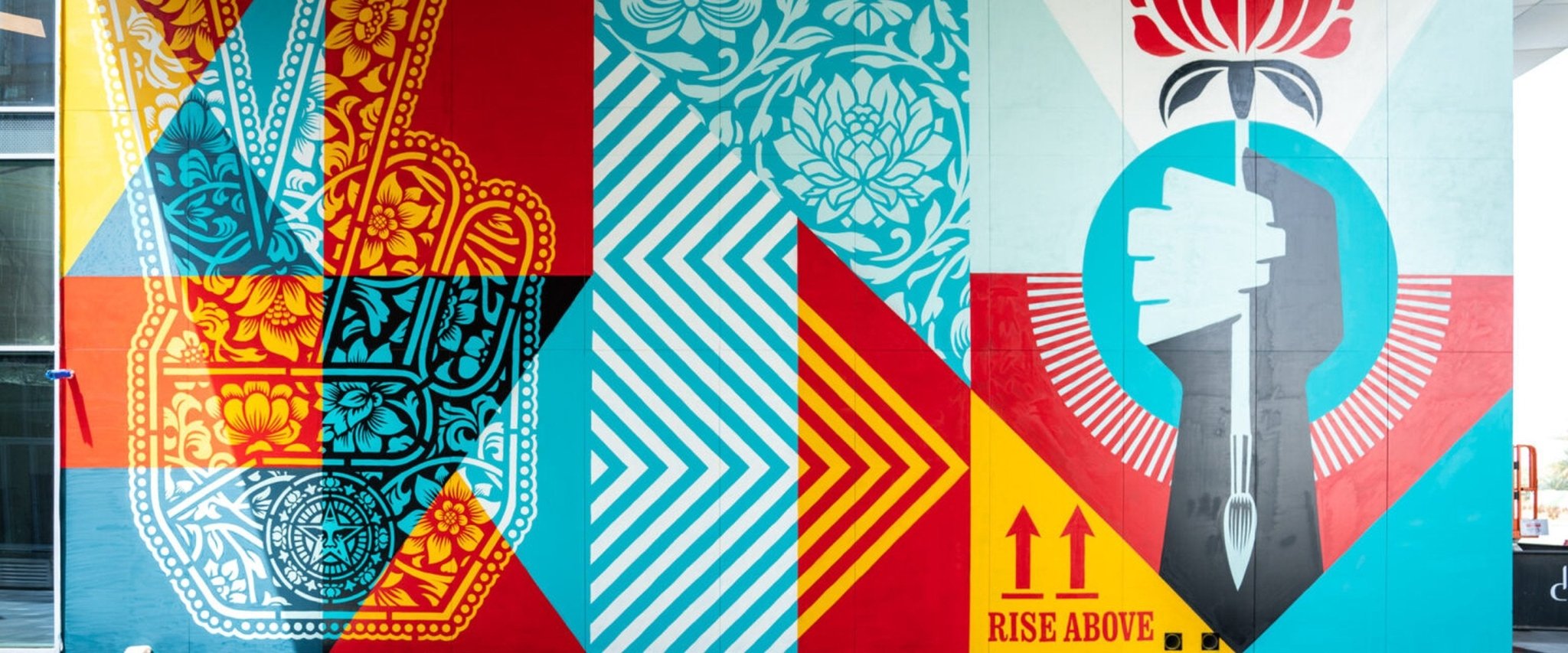
Six specific drivers determine whether a Shepard Fairey print sells for $150 or $15,000. The subject's cultural weight, edition size, condition, format, provenance, and release era each carry measurable price impact—and a single unfavorable factor can cut value in half. Here is exactly how each driver works and what price differential to expect.
Why Fairey's Market Is Worth Understanding
Shepard Fairey is the most liquid, most-traded street-art name after Banksy. His catalogued output exceeds 450 editioned prints with institutional holdings at the Smithsonian National Portrait Gallery, MoMA, the V&A, LACMA, and the Boston ICA. The 2023 auction record for the original HOPE collage reached $950,000 at Santa Monica Auctions. That benchmark lifts comp values across every tier in the catalogue.
Gauntlet Gallery has tracked Fairey market comparables since 2012. Our 160,000+ comparable sales database covers every major print tier, from standard screen prints to HPM hand-painted multiples, which is why the price impacts below are specific rather than approximate.
For a full overview of the market, visit our Shepard Fairey Collector Guide.
The 6 Valuation Drivers
1. Subject and Cultural Weight
No other driver moves the price needle as far or as fast as subject matter. Fairey's political and cultural-icon prints—HOPE (Obama), OBEY portraits of Ruth Bader Ginsburg, Martin Luther King Jr., Nelson Mandela, and John Lennon—outperform generic OBEY-imagery pieces by 3–5x in recent comp windows.
The HOPE poster is the clearest benchmark. A standard signed screen print from the 2008 run in fine condition trades in the $800–$1,400 range. A signed, similarly conditioned print on a niche architectural or pattern subject from the same era often trades at $150–$350. Same artist, same era, same edition structure—subject alone explains a 4–6x spread.
Why cultural anchors hold value: Museum acquisitions validate a subject permanently. When the Smithsonian places a HOPE collage in the National Portrait Gallery's permanent collection, every secondary-market HOPE print trades within a system endorsed by one of the world's most credible collecting institutions. Niche subjects do not have that floor.
2. Edition Size
Edition size is the supply-side variable every serious collector tracks. Fairey's post-2008 standard runs are typically 450 signed and numbered prints. Pre-2008 editions were smaller—often 50–200—which is a large part of why early works carry structural premiums today.
| Edition Type | Typical Run Size | Price Premium vs. Standard /450 |
|---|---|---|
| Standard numbered (/450) | 450 | Baseline |
| Artist Proof (AP) | 10–25 | +50–100% |
| Remarque / hand-annotated | 5–15 | +100–200% |
| Pre-2008 limited run (/100 or less) | 50–150 | +100–300% (subject-dependent) |
| HPM (Hand-Painted Multiple) | 5–20 | +300–600% |
Artist Proofs carry the same image but mark the printer's quality-check pulls. In practice, APs are identical in presentation to numbered prints but are issued in runs of 10–25, making them 18–45x scarcer than a /450 edition. That scarcity consistently translates to 50–100% price premiums at auction and in dealer inventory.
3. Condition
Condition is the most destructive valuation variable because damage is permanent and prevalent. Fairey prints are almost universally on archival paper stock, but that paper is acutely vulnerable to UV exposure.
Sun fading destroys 30–60% of value. A HOPE screen print that has been displayed in direct or indirect sunlight without UV-filtering glass will show visible yellowing and color shift. In Gauntlet Gallery's comp database, faded examples of the same print consistently trade at a 30–60% discount to mint unframed examples. On a print with a $1,200 mint-condition comp, that translates to a $360–$720 value loss from storage decisions alone.
Additional condition factors that suppress value:
- Pinholes or tack marks: common on prints that were wall-displayed without framing. Each hole is a permanent defect. Discount: 10–25%.
- Foxing or moisture damage: brown spots caused by humidity or mold. Discount: 20–40%.
- Tape or mounting residue: adhesive residue on the verso can bleed through over time. Discount: 15–30%.
- Framing with acidic materials: non-archival mats cause edge browning, often not visible until the print is unframed. Discount: 10–20%.
The collector rule: mint and unframed (in original tube or flat file storage) is the highest-value storage state. A framed print of unknown provenance history carries condition risk until inspected.
4. Format and Surface
Fairey works in multiple formats and surfaces, and the market prices them very differently.
Diamond Dust editions carry a 40–80% premium over standard screen prints of the same image. Industrial glass crystals applied to the print surface create a tactile, light-catching effect that collectors value for display presence. Diamond Dust runs are typically 50–100 prints vs. 450 for standard editions—smaller supply compounds the premium.
HPM (Hand-Painted Multiples) are in a different category entirely. These are screen-printed bases with additional hand-applied paint by Fairey or under his direct supervision. Edition sizes of 5–20 and verifiable hand-work push HPM prices 3–6x above standard print comps for the same image. A standard HOPE print at $1,200 comps against an HPM version of comparable subject matter in the $5,000–$8,000 range.
Standard screen prints on paper are the baseline. Prints on wood, aluminum, or canvas are rarer but do not universally command premiums—buyer preference for the medium matters, and liquidity is lower for unusual substrates.
5. Provenance
Provenance answers two questions: where did this print come from, and can you prove it? The difference between a documented primary-sale print and an unverified secondary-market print can be 20–40% in realized price—and the difference between an authenticated print and a forgery is 100% of the value.
The forgery problem in the Fairey market is not theoretical. Approximately 30% of online Fairey listings show authentication red flags, according to Gauntlet Gallery's analysis of the secondary market. The most common issues are inkjet reproductions on archival paper sold as screen prints, unsigned prints with signatures added post-production, and authentic prints from lower-value editions relabeled as higher-value variants.
Provenance hierarchy by value impact:
- Primary sale documentation (original Obeygiant.com receipt or gallery receipt from a Fairey-authorized release)—highest value, easiest to authenticate
- Known institutional or serious-collector provenance—significant premium over anonymous ownership history
- Auction-house records—Heritage, Sotheby's, Christie's provide independent authentication logs
- Unverified private-party history—the discount zone; buyer assumes full authentication risk
6. Release Era
Pre-2010 Fairey prints carry a structural scarcity premium that post-2010 editions do not and cannot replicate. The reasons are compounding.
Smaller original editions: Before the HOPE moment normalized 450-print runs, Fairey often printed 50–200 copies. A 2005 print in a run of 100 has an original supply roughly 4.5x smaller than a 2012 print in a run of 450.
Natural attrition over 15+ years: Prints that were rolled, stored in garages, displayed in sunlight, or sold at swap meets without documentation are effectively removed from the authenticated market. The surviving pool of condition-sound, provenance-documented pre-2010 prints shrinks each year.
No central archive at time of release: Fairey's studio did not maintain a centralized digital archive for early releases the way it does now. Verified examples of early works carry a premium that reflects the scarcity of documentation.
In practice: a pre-2010 signed Fairey screen print in fine condition with documentation routinely trades at 2–4x a comparable post-2010 print of similar subject matter and edition size.
How the Drivers Compound
A HOPE-subject, pre-2010, AP-edition, Diamond Dust, primary-documented Fairey in mint condition hits every favorable driver simultaneously. Favorable drivers multiply rather than add—each one increases the relevance of the next. The inverse is equally true: a niche-subject, post-2012, /450 standard edition with UV fading and no provenance is effectively a commodity item with limited upside.
Most prints in the real market fall somewhere between those poles. The 6-driver framework gives collectors a structured way to evaluate where on that spectrum any specific piece sits—and what price is justified before negotiation begins.
Start Building Your Fairey Collection
Gauntlet Gallery carries authenticated Shepard Fairey prints across multiple tiers, subject categories, and edition types—each with documented provenance and condition notes. Browse the current inventory: