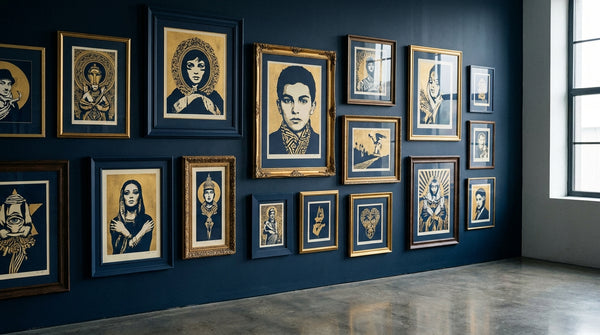
Shepard Fairey produces five distinct edition types: standard screen prints, large-format screen prints, letterpresses, Diamond Dust and metallic variants, and HPMs (Hand-Painted Multiples). Each tier differs in how it is made, how many exist, what it costs, and how quickly it resells. Understanding which tier you are buying is the single most important decision in the Fairey market — and, given a forgery rate estimated at approximately 30% of online listings, verifying you are buying an authentic example of the right tier is equally critical.
For deeper context on navigating the broader Fairey market, read our Shepard Fairey Collector Guide.
Why Edition Type Matters Before Price
Fairey has catalogued more than 450 editioned prints since the early 1990s. The same image — say, the OBEY Giant face — may appear as a $95 standard screen print in an edition of 700, a $1,200 large-format variant in an edition of 300, and a $6,000 HPM in an edition of 18. Without knowing the edition type, a price comparison is meaningless. Gauntlet Gallery has tracked Fairey market comps since its founding in 2012, and our 160,000+ comparable sales database makes clear that edition type is the primary determinant of per-print price floor and resale velocity.
The 5 Shepard Fairey Edition Types
1. Standard Screen Print
Standard screen prints are the backbone of Fairey's commercial catalogue. They are produced by pushing ink through a mesh screen onto paper — typically 100 lb. or 80 lb. coated stock — using anywhere from two to ten ink layers depending on the design's complexity. Most editions run 450–700 signed and numbered copies.
How it is made: Flatbed screen printing. Each colour is a separate pass. Registration marks confirm authentic multi-layer production.
Typical edition size: 450–700 prints, signed and numbered by Fairey in pencil.
Price range: $95–$350 at primary release; $200–$800 on secondary market for standard subjects. Cultural-anchor subjects (HOPE, RBG) regularly clear $1,500–$3,500.
Authentication markers: Pencil signature and edition number on the bottom margin; Obey Giant Art COA with serial number matching the print; paper weight minimum 80 lb.; ink layers show slight physical relief when viewed at a raking angle.
Resale liquidity: Highest of all tiers. The largest buyer pool means faster sales at predictable comps.
Who should buy it: First-time Fairey collectors, buyers with budgets under $1,000, and anyone seeking high liquidity with a documented exit market.
2. Large-Format Screen Print
Large-format editions use the same screen-printing process but on oversized sheets — typically 24×36 inches or larger, compared to the standard 18×24. The larger substrate requires heavier paper, more ink, and greater printing precision. Edition sizes are smaller to reflect production costs.
How it is made: Same multi-layer screen printing as standard editions, executed on oversized heavy-weight paper (often 100–130 lb. stock).
Typical edition size: 200–500 prints, signed and numbered.
Price range: $200–$600 at primary; $400–$1,800 on secondary. Oversized HOPE variants have cleared $4,000+ in recent auction cycles.
Authentication markers: Same pencil signature and COA requirements as standard. Confirm paper dimensions match the known edition spec — counterfeiters frequently use undersized paper.
Resale liquidity: Strong. Slightly smaller buyer pool than standard, but wall-impact premium attracts interior-design buyers.
Who should buy it: Collectors prioritising visual impact for display, and buyers who want a proven market tier one step up from entry-level.
3. Letterpress
Letterpress editions are produced on a relief printing press — typically a vintage Vandercook or Heidelberg — which physically impresses raised type and imagery into the paper surface. The result is a tactile, debossed print with an aesthetic closer to fine-press typography than street-poster printing. Fairey has collaborated with specialty letterpress studios for a subset of his catalogue.
How it is made: Relief printing using hand-set or photo-polymer plates. The press physically compresses the paper, leaving a permanent impression in the substrate.
Typical edition size: 100–200 prints, signed and numbered.
Price range: $250–$750 at primary; $500–$1,500 on secondary.
Authentication markers: Physical deboss impression visible and tactile on the paper surface — this cannot be replicated by digital printing. Verify COA notes the letterpress production method and studio.
Resale liquidity: Moderate. The technique is distinctive and desirable among print collectors, but the buyer pool is narrower than for standard screen prints.
Who should buy it: Collectors with a fine-press or typography background, and buyers seeking a structurally differentiated tier within the Fairey catalogue at a manageable price point.
4. Diamond Dust and Metallic Variants
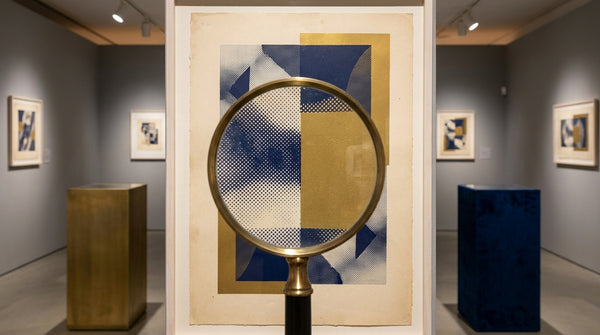
Diamond Dust prints begin as standard screen prints and then receive an overcoating of crushed glass particles applied while the surface ink is still tacky. The result is a print that refracts light and shimmers under any illumination. Metallic variants substitute silver or gold inks in the printing process itself, producing a different but equally distinctive optical effect.
How it is made: Standard screen print base with a hand-applied or machine-applied Diamond Dust coating on designated areas, or screen printing with metallic inks that contain actual metal particles.
Typical edition size: 50–150 prints, signed and numbered.
Price range: $500–$1,500 at primary (depending on base image); $1,000–$4,500 on secondary. Diamond Dust variants of politically significant images carry the highest premiums.
Authentication markers: The glass-particle surface is physically detectable under close examination — it will catch and scatter a penlight. Digital forgeries cannot replicate the texture. COA should explicitly identify the edition as a Diamond Dust or metallic variant.
Resale liquidity: Good. Visual distinctiveness creates strong demand from display-focused buyers. Smaller edition sizes support price floors.
Who should buy it: Collectors who prioritise visual drama, buyers acquiring Fairey works for prominent display contexts, and investors seeking a smaller edition size with clear differentiation from standard prints.
5. HPM (Hand-Painted Multiple)
HPM — Hand-Painted Multiple — is the most labour-intensive and highest-value tier in Fairey's print catalogue. The process begins with a screen-printed base on heavy-weight paper or wood panel. Fairey then manually applies collage elements (torn vintage paper, magazine fragments, texture materials) and direct paint, ensuring that each copy in the edition is genuinely unique despite sharing a common printed foundation. No two HPMs are identical.
How it is made: Screen-printed base layer; hand-applied collage elements; direct paint application by Fairey. The artist's hand touches every copy.
Typical edition size: 10–50 prints, signed and numbered — often the smallest denominator in his catalogue.
Price range: $3,000–$15,000 at primary and secondary. Iconic-subject HPMs with documented provenance have exceeded $20,000 in private sales.
Authentication markers: Unique collage and paint elements that vary copy to copy. COA must explicitly identify the work as an HPM and describe the hand-application. Any two copies from the same HPM edition should look related but not identical.
Resale liquidity: Moderate-to-high given the price tier. The buyer pool is smaller, but HPMs attract both print collectors and painting collectors, broadening the demand base.
Who should buy it: Established collectors with $5,000+ print budgets seeking the closest thing to a unique Fairey work without entering the fine-art auction market, and investors focused on the long-term appreciation profile of small-edition, hand-touched works.
Comparison Table: All 5 Edition Types
| Edition Type | Typical Edition Size | Primary Price Range | Secondary Market Range | Resale Liquidity | Key Authentication Marker |
|---|---|---|---|---|---|
| Standard Screen Print | 450–700 | $95–$350 | $200–$3,500+ | Highest | Pencil sig + COA serial match |
| Large-Format Screen Print | 200–500 | $200–$600 | $400–$4,000+ | Strong | Paper dimensions vs. known spec |
| Letterpress | 100–200 | $250–$750 | $500–$1,500 | Moderate | Physical deboss impression |
| Diamond Dust / Metallic | 50–150 | $500–$1,500 | $1,000–$4,500 | Good | Light-scattering glass surface |
| HPM (Hand-Painted Multiple) | 10–50 | $3,000–$15,000 | $3,000–$20,000+ | Moderate-High | Unique collage variation + COA |
Authentication Applies Across Every Tier
Forgeries appear at every price point. A $150 fake screen print is as damaging to a collection as a $10,000 fake HPM. Gauntlet Gallery's 160,000+ comparable sales database includes provenance flags and edition-type verification data built up since our founding in 2012. For every tier, the core authentication checklist is the same: verify the pencil signature, match the COA serial number to the print, confirm paper weight and dimensions against the published edition spec, and scrutinise the physical production characteristics unique to that edition type. For HPMs, photograph every instance of hand-application and compare against documented examples. For Diamond Dust prints, examine the surface under raking light — no flat inkjet reproduction will pass that test.
If you are ever uncertain about the tier or authenticity of a work you are considering, contact Gauntlet Gallery before purchase. Our team reviews authentication documentation daily and can flag discrepancies before a transaction closes.
Which Edition Type is Right for You?
The right tier depends on budget, display intent, and investment horizon. New collectors and those focused on liquidity should start with standard screen prints — the market is deep, comps are abundant, and exit is straightforward. Collectors seeking visual impact or a step up in rarity should consider large-format prints or Diamond Dust variants. Collectors building a serious Fairey holding with a long time horizon and $5,000+ per-piece budgets should focus on HPMs, where the smallest edition sizes and hand-involvement by the artist create the strongest scarcity profile.
Letterpress editions are a strong niche choice for collectors who specifically value the print medium as craft — the deboss impression is a permanent record of physical force, which no other tier in Fairey's output replicates.
Across all tiers, political and cultural-anchor subjects — the 2008 HOPE portrait, Ruth Bader Ginsburg, Martin Luther King Jr., Nelson Mandela — have consistently outperformed generic OBEY imagery by 3–5x in recent comp windows. Subject selection within any given tier materially affects both price floor and resale velocity.
Browse our current inventory of authenticated Shepard Fairey prints across all five edition types at Gauntlet Gallery — Shepard Fairey Collection. Every piece ships with matching COA documentation and full provenance records.