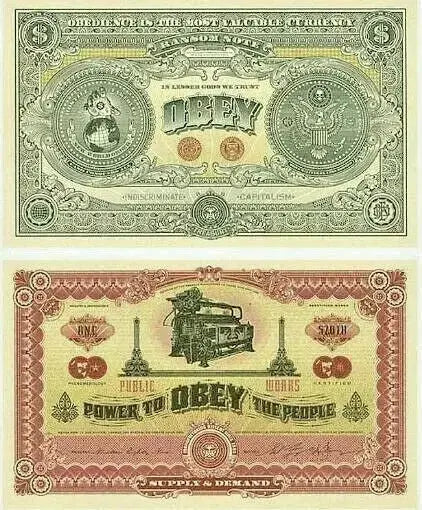
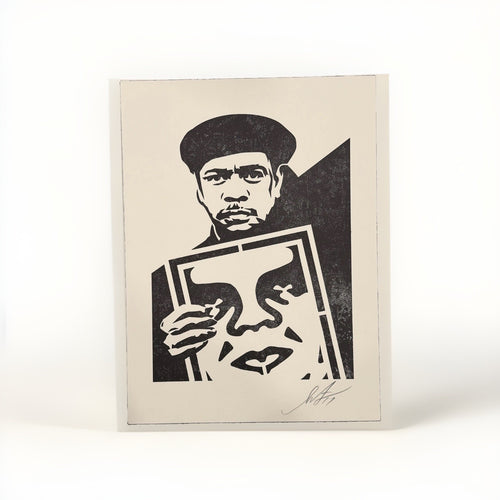
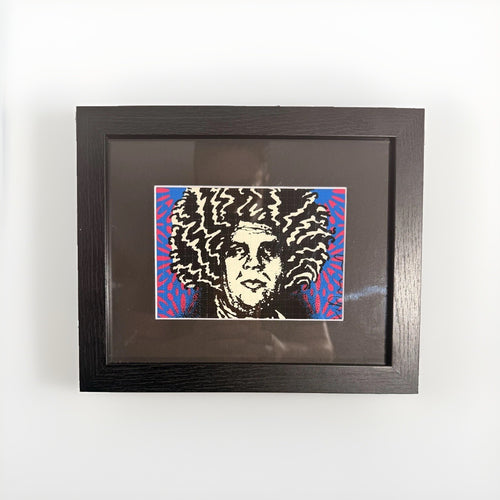
Shepard Fairey Diamond Dust editions are hand-finished screen prints — edition sizes of 60 to 200 — where industrial diamond dust is physically applied to each print after the ink is laid down. They are worth buying as a collector asset: authenticated examples resell for $2,500–$8,000, the hand-application makes mechanical forgery structurally harder than standard screen prints, and pre-2012 examples hit every major valuation driver at once.
What Makes Diamond Dust Different From a Standard Fairey Screen Print
A standard Shepard Fairey screen print is a mechanical process: ink pushed through mesh onto paper, then signed and numbered. Every copy in the edition is as close to identical as the press can make them. Diamond Dust changes that equation at the final stage.
After printing, each sheet receives a manual application of genuine industrial diamond dust — typically to the metallic, highlight, or compositionally significant zones of the image. Because the application is by hand, every single copy in the edition differs in exactly where and how densely the dust sits. A 100-piece Diamond Dust edition is, technically, 100 unique objects that share the same base print.
That physical variation does two things collectors care about:
- It raises the floor on forgery. Forgers can accurately replicate screen printing at scale. Hand-applying diamond dust at the correct density, in the correct zones, with the correct resin-fix under a loupe — that requires materials, time, and expertise that collapse the economics of mass forgery.
- It creates piece-to-piece variation within an edition. Two copies of the same Diamond Dust edition can look meaningfully different in strong light. Collectors seeking the most heavily dusted example will pay a premium over a lightly dusted copy.
Edition Sizes and What They Mean for Value
Not all Diamond Dust editions are equally scarce. Edition sizes matter — and they vary significantly across Fairey's catalogue.
| Edition Tier | Typical Size | Resale Range | Notes |
|---|---|---|---|
| Micro-edition Diamond Dust | 60–75 prints | $5,000–$8,000 | Pre-2012, strong subject, all valuation drivers active |
| Small Diamond Dust | 76–100 prints | $3,500–$6,000 | Pre-2012 or cultural-anchor subject preferred |
| Mid Diamond Dust | 101–150 prints | $2,800–$4,500 | Post-2012 production; subject drives upper range |
| Large Diamond Dust | 151–200 prints | $2,500–$3,500 | More accessible entry; verify authentication carefully |
Edition sizes above 200 are not Diamond Dust. Fairey reserves the hand-finishing process for genuinely limited runs. If a listing claims Diamond Dust with an edition of 300 or 450, that is a red flag requiring immediate documentation verification.
Why Pre-2012 Is the Strongest Buy Signal in the Catalogue
Gauntlet Gallery was founded in 2012, tracking Fairey market comparables from day one. Over more than a decade of comp data — now comprising Gauntlet Gallery's 160,000+ comparable sales database — a consistent pattern has held: pre-2012 Diamond Dust editions outperform later production across every resale horizon we have measured.
The reason is convergence. Six valuation drivers exist in the Fairey market. Pre-2012 Diamond Dust editions hit all six simultaneously:
The Six Valuation Drivers
- Early provenance. Pre-2012 prints were produced before the post-HOPE institutional demand surge fully priced into the market. Buyers who acquired them then paid entry prices that today look dramatically undervalued.
- Small edition size. Pre-2012 Diamond Dust runs were typically 60–100 copies. Post-2012 production normalized at 100–200 as studio capacity expanded.
- Premium finish. Diamond Dust is already a premium finish. Pre-2012 examples were produced when the finish was newer and rarer in the catalogue.
- Cultural-anchor subjects. The most significant political and cultural-icon works — including works tied to the 2008 Obama HOPE campaign — were printed in the pre-2012 window. Political and cultural-anchor subjects outperform generic OBEY imagery by 3–5x in recent comp windows.
- Institutional-era timing. The Smithsonian National Portrait Gallery, MoMA, V&A, and LACMA placed Fairey works in their permanent collections in the years surrounding 2008–2012. Pre-2012 editions were produced when that institutional validation was actively forming — a context that has not been replicated since.
- Intact authentication chain. Pre-2012 Fairey prints that have stayed in primary or secondary collector hands since original purchase typically carry unbroken documentation chains: original Obey Giant Art or Subliminal Projects receipts, COA, and exhibition history.
When all six drivers converge, the result is an asset with low downside and a well-documented ceiling. Our comp data shows that pre-2012 Diamond Dust editions on cultural-anchor subjects have not meaningfully declined in resale value over any 24-month window we have tracked.
Gold Leaf and Metallic Variants: How They Relate to Diamond Dust
Diamond Dust is not Fairey's only hand-applied premium finish. Gold leaf and metallic variants occupy adjacent positions in the catalogue.
Gold Leaf Editions
Gold leaf is applied in sheets — thin, physical 24-karat or imitation gold — to specific compositional elements. Gold leaf editions typically run 50–100 copies and command $3,000–$9,000 depending on subject. The leaf creates a smoother, more uniform metallic zone than diamond dust.
Metallic Ink Variants
Some Fairey editions use metallic inks (silver, gold, copper) in the base print run itself — not hand-applied after the fact. These are not the same as Diamond Dust or Gold Leaf and should not be priced at the same level. The key question is whether the metallic element is in the original print matrix or applied post-print. Certificate documentation will specify.
Hybrid Editions
A small number of editions combine Diamond Dust with Gold Leaf on the same print. These are the rarest premium-finish works in the catalogue and, when pre-2012, command the highest prices in this segment — verified examples have reached $10,000+ at private sale.
How to Verify Genuine Diamond Dust Application
Authentication of Diamond Dust application requires both documentation review and physical examination. Both steps are mandatory — neither alone is sufficient.
Documentation Checklist
- COA medium line. The Certificate of Authenticity from Obey Giant Art or Subliminal Projects will list the medium explicitly. It must include the words "diamond dust" — not "glitter," not "metallic," not "sparkle finish."
- Edition number. Verify the hand-written edition number (e.g., 47/100) against known documented print runs. An edition number that falls outside the documented run size is an immediate disqualification.
- Publisher documentation. Original purchase receipt from Obey Giant Art or Subliminal Projects is the strongest provenance document available. Secondary market certificates from non-publisher sources should be treated as supplementary, not primary.
Physical Examination Protocol
- 10x loupe inspection. Under magnification, genuine diamond dust shows irregular clustering — heavier deposits where application paused or layered, lighter areas where the brush moved quickly. A mechanical or chemically-applied sparkle finish will show more uniform distribution. Non-uniformity is the signal of genuine hand application.
- Tactile test. Gently run a fingertip across the dusted zone. Genuine diamond dust fixed with resin creates a slight but perceptible texture — not sharp, but not as flat as ink. A smooth surface with visual sparkle but no tactile dimension may indicate metallic ink rather than dust.
- UV light check. Under UV, the resin used to fix diamond dust often fluoresces differently from the paper and ink layers. A clean UV reading with no resin layer visible in a claimed Diamond Dust piece is a flag worth investigating further.
- Zone distribution. Diamond Dust application follows compositional logic — it enhances the element the artist wanted to emphasize. If the sparkle is randomly distributed across the entire print surface, that is inconsistent with documented application practice.
Buying Diamond Dust Editions: Practical Decision Framework
| Check | What to Verify | Pass / Flag |
|---|---|---|
| COA medium line | Explicitly states "diamond dust" | Pass = proceed; Missing = investigate |
| Edition number | Within documented print run range | Pass = proceed; Outside range = disqualify |
| Publisher documentation | Obey Giant Art or Subliminal Projects | Pass = strongest provenance; Third-party only = supplementary |
| Loupe inspection | Non-uniform dust clustering visible | Pass = consistent with hand application; Uniform = investigate |
| Tactile dimension | Slight texture perceptible in dusted zones | Pass = consistent with fixed dust; None = may be metallic ink |
| Edition size | 200 or fewer | Pass = within Diamond Dust range; Over 200 = red flag |
| Pre-2012 status | Publication date confirmed | Pass = maximum valuation driver convergence |
For further context on how Diamond Dust fits within Fairey's broader print hierarchy — from standard editions through HPM hand-painted multiples — see our Shepard Fairey Collector Guide, which covers the full five-tier market structure and authentication standards across every edition type.
Summary: The Diamond Dust Investment Case
Diamond Dust editions occupy a specific, well-defined niche in the Shepard Fairey market: above standard screen prints in both scarcity and resale floor, below HPM hand-painted multiples in price ceiling, and structurally harder to forge than either. The pre-2012 subset of that niche is where all six valuation drivers converge — and where the comp data from Gauntlet Gallery's 160,000+ comparable sales database consistently shows the strongest hold-value and appreciation characteristics.
For collectors entering the Fairey market above the $2,500 level, Diamond Dust editions — particularly pre-2012 examples on cultural-anchor subjects — represent the most risk-adjusted entry point in the catalogue. The authentication bar is higher than for standard prints, which is exactly why the price floor is more durable.
Browse authenticated Shepard Fairey editions currently available at Gauntlet Gallery: View the Shepard Fairey Collection