Muhammad Ali – Heavyweight Ideals by Shepard Fairey: Collector Guide, Value & What to Know
The Shepard Fairey Muhammad Ali – Heavyweight Ideals print is one of the most commanding pieces in the OBEY Giant catalog — a large-format screen print that renders The Greatest in the unmistakable propaganda-poster aesthetic Fairey has refined over three decades. If you are asking whether this print is worth buying, the answer is yes: Ali sits at the intersection of sporting legend, civil rights history, and street-art iconography, making this a dual-market collectible with enduring demand from both fine-art collectors and sports memorabilia buyers. Fairey's limited edition output means supply is permanently capped, and heavyweight cultural subjects consistently outperform on the secondary market.
About Muhammad Ali – Heavyweight Ideals
Muhammad Ali is widely regarded as the greatest heavyweight boxer in history — a three-time world champion who defeated Sonny Liston, Joe Frazier, and George Foreman, and who defined an era of sport with sheer athletic genius and theatrical personality. But Ali's legacy extends far beyond the ring. His refusal to be inducted into the U.S. military during the Vietnam War on religious and moral grounds cost him his championship titles, three and a half years of his prime, and nearly his freedom — a sacrifice that made him a symbol of principled resistance for a generation. He converted to Islam, changed his name, and spoke with unflinching clarity about race in America when doing so carried real personal cost. For millions, he remains the clearest example of an athlete using his platform without apology.
Shepard Fairey chose Ali as a subject for the same reason he gravitates toward figures whose images carry ideological weight. The "Heavyweight Ideals" framing is characteristically Fairey — the pun is deliberate, layering Ali's physical dominance with the philosophical stance he embodied. Fairey's entire career has been built around the idea that icons can be reclaimed, recontextualized, and returned to the public as visual arguments rather than passive portraits. Ali, who fought institutional power at every level, is a natural fit for the OBEY aesthetic. The result is a print that functions as both a tribute and a statement.
The Print — What You Are Getting
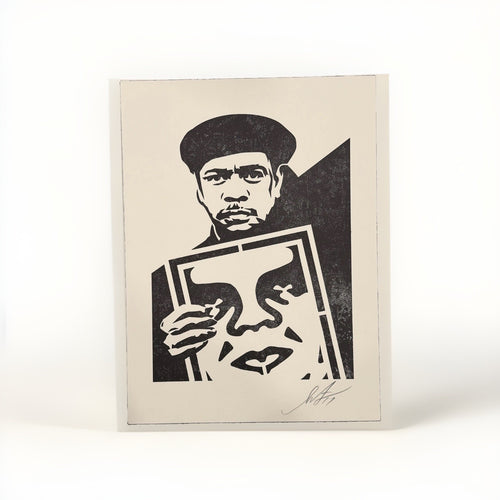
The Muhammad Ali – Heavyweight Ideals is produced as a hand-pulled screen print by the OBEY Giant studio in Los Angeles. Standard Fairey screen prints in this tier run in editions of 150 to 450, with smaller variant editions (red, gold, or black colorways) often limited to 50–100. The visual language is immediately recognizable: bold flat color fields, high-contrast halftone overlays, distressed texture that evokes Soviet-era propaganda and 1960s offset lithography, and Fairey's signature integration of graphic border elements and typographic framing. The standard format is 18x24 inches, which fits conventional gallery framing and displays well in both residential and commercial settings. Each print is produced on heavy archival stock, typically Cream Speckletone or similar, chosen for its response to oil-based screen inks and its long-term archival stability.
Authentication and Provenance
Authentication for Shepard Fairey prints is straightforward and self-contained within the OBEY Giant ecosystem. Genuine prints carry a pencil signature from Fairey in the lower right, a hand-written edition number (e.g., 125/300) in pencil lower left, and the OBEY blind-deboss stamp pressed directly into the paper — a tactile security feature that cannot be reproduced by scanning or reprinting. These three elements together constitute the authentication standard recognized by major auction houses including Heritage Auctions, Bonhams, and Phillips. No third-party certificate of authenticity is required, and no third-party COA adds meaningful value to a Fairey print — the OBEY documentation is the market standard. Buyers should verify the blind deboss under raking light before purchase. Prints acquired directly from the OBEY Giant shop or from established galleries like Gauntlet Gallery come with full provenance chain.
Value in Context
Muhammad Ali prints by Shepard Fairey occupy the premium tier of the OBEY secondary market. Music and cultural icon subjects — Ali, Bob Marley, Nina Simone — consistently command higher multiples than architectural or abstract works because they carry two collector bases: the fine-art buyer who collects Fairey specifically, and the subject-matter collector (sports memorabilia, civil rights history, boxing) who may be encountering Fairey as a gateway. Standard edition Fairey screen prints in strong condition typically trade in the $300–$800 range at auction; rarer variants, lower-numbered copies, and subjects with the breadth of cultural resonance Ali carries can push well above that. The Heavyweight Ideals subject matter — Ali as ideological figure rather than purely athletic one — positions this print at the upper end of the cultural-icon tier. Condition is paramount: no creases, no foxing, no UV fading. Unframed and stored flat in archival sleeves is the ideal holding condition.
FAQ
For a comprehensive overview of Fairey's editions, authentication, and collector strategy, see our Shepard Fairey Collector Guide.
Browse all available Shepard Fairey prints at Gauntlet Gallery → Shepard Fairey.