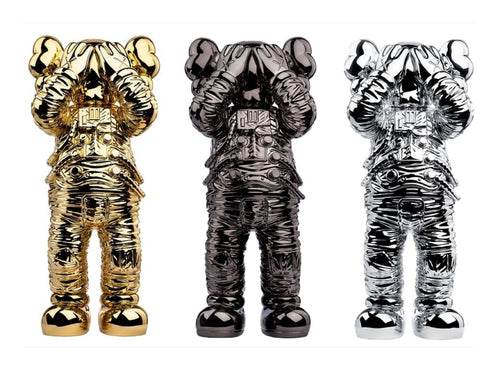
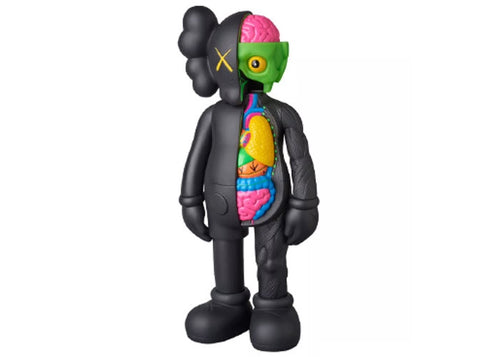
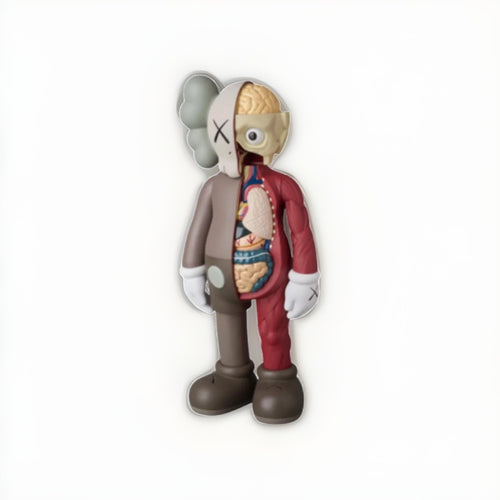
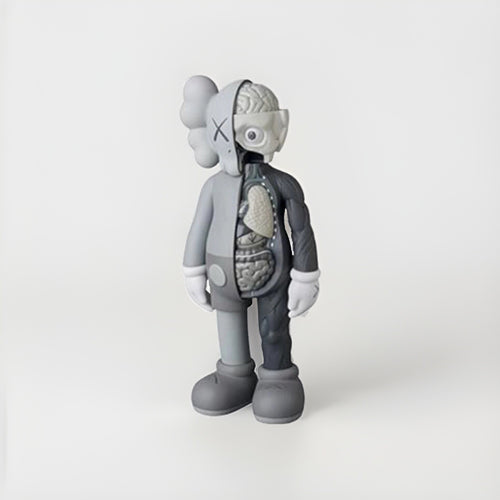
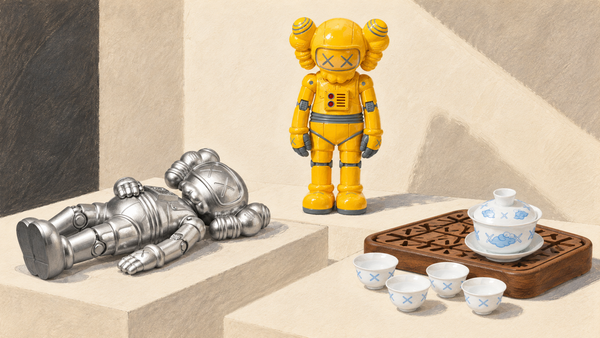
KAWS Original Fake was the flagship retail brand and Aoyama, Tokyo store that Brian Donnelly operated in partnership with Medicom Toy from 2006 to 2013. It served as the exclusive distribution channel for limited Companion variants, BFF figures, and OriginalFake-branded apparel during the artist's peak commercial expansion period.
What Was KAWS Original Fake?
OriginalFake (often written "OriginalFake" as a single word, or stylized "OF") was more than a retail concept. It was a curated cultural ecosystem that fused designer toys, streetwear, and contemporary fine art into a single physical location in the Aoyama district of Tokyo. Launched in April 2006 as a 50/50 joint venture between KAWS and Medicom Toy CEO Tatsuhiko Akashi, the project gave Brian Donnelly something almost no contemporary artist had at the time: direct institutional control over the supply, pricing, and release cadence of his most coveted collectibles.
For seven years, the OriginalFake store at 5-3-22 Minami-Aoyama functioned as a global pilgrimage site. Collectors flew in from Hong Kong, New York, London, and Seoul for individual drops. Lines formed before dawn. The brand closed permanently in July 2013 — and that closure transformed every OF-era piece from a current-season collectible into a permanently finite asset class.
The Medicom Toy Partnership: Why It Mattered
Medicom Toy, founded in 1996 by Akashi, had already pioneered the Be@rbrick platform and developed deep relationships with Japanese toy manufacturing infrastructure. When KAWS and Medicom formalized the OriginalFake joint venture in 2006, the partnership gave Donnelly access to production quality, vinyl tooling, and a distribution network that no Western art-toy operator could match.
The structure was deliberate. Medicom controlled manufacturing and Japanese retail. KAWS controlled artistic direction, edition sizing, and the release calendar. Both parties shared revenue and inventory exposure. This vertical alignment is the reason OF-era Companions, BFFs, and Be@rbricks display the production consistency that authentication specialists still use as a baseline reference.
The Aoyama Store as Cultural Space
The physical store occupied roughly 70 square meters of street-level Aoyama retail. The interior was minimalist concrete and white walls — a deliberate counterpoint to the saturated color palette of the merchandise itself. Display cases held current and archival KAWS works alongside collaboration product from fragment design, Original Fake apparel, and Be@rbrick releases.
For the collector class that emerged in the mid-2000s, walking through the OriginalFake doors was a credentialing moment. Photographs of the storefront circulated on early streetwear blogs (Hypebeast, Slamxhype, Honeyee) and helped establish KAWS as a globally networked figure rather than a regional Brooklyn-and-Tokyo artist.
Limited Variants Released Exclusively Through Original Fake
The OF era produced some of the most sought-after Companion and BFF colorways in the KAWS catalog. Many were released in editions of 500 to 1,000 units, sold only at the Aoyama store or via the store's online portal during narrow release windows.
| OF-Era Release Category | Years Active | Notable Characteristics | Secondary Market Status |
|---|---|---|---|
| Companion store-exclusive colorways | 2006-2013 | Small editions, OF box stamp, Aoyama-only release | Strong documented premium over open-edition equivalents |
| BFF figures (OF originals) | 2009-2013 | Plush-textured surface, OF-branded packaging | Highly liquid at auction houses and verified resale |
| Be@rbrick collaborations (KAWS x Medicom) | 2006-2013 | 100% and 400% pairs, 1000% standalone releases | Provenance-sensitive; OF receipts add value |
| OF apparel and accessories | 2006-2013 | Tees, hoodies, hats, ceramics, skate decks | Lower entry point; collected as full ecosystem |
| Print and signed multiples | 2008-2013 | Released alongside major figure drops | Bridge category between toy and gallery collecting |
Why the 2013 Closure Was the Peak-Influence Moment
When OriginalFake closed in July 2013, KAWS was at the inflection point of his transition from designer-toy figure to globally collected contemporary artist. The closure was not a retreat — it was a strategic consolidation. Donnelly had begun working more directly with institutional venues (Brooklyn Museum, Aldrich Contemporary, PAFA) and major gallery representation (Honor Fraser, Galerie Perrotin) was either active or imminent.
The closure created an immediate scarcity effect. Every Companion, BFF, Be@rbrick, and apparel item produced during the 2006-2013 window became permanently bounded. No new OF-stamped product would ever be made. For a collector base that had grown accustomed to regular drops, the supply faucet shut off overnight — and the secondary market repriced accordingly.
The Institutional Control Lesson
OriginalFake demonstrated something that has since become a template for artist-led commercial brands: when an artist controls distribution rather than licensing it, the artist captures both the primary margin and the long-term provenance narrative. Every OF-era piece carries documented chain-of-custody back to a single retail location operated by the artist himself. That clean provenance is part of what makes OF-era inventory command a consistent premium in the documented secondary market.
The OF Era and the Current Auction Market
KAWS's auction trajectory has been one of the most aggressive in 21st-century contemporary art. The 2019 sale of The KAWS Album at Sotheby's Hong Kong achieved $14.7 million in April 2019 — at the time the highest auction result for any work by KAWS. That single result repositioned the entire KAWS catalog, including OF-era collectibles, within a credible blue-chip framework.
OF-era pieces sit at the intersection of two collector communities: vinyl-figure collectors who prize completeness and condition, and contemporary art collectors who value provenance and edition integrity. Pieces with original OF packaging, receipts, and intact accessories occupy the highest tier of the documented secondary market for the period.
Authenticating OF-Era Pieces
The OriginalFake closure also created a forgery incentive. Counterfeit OF packaging, fake store receipts, and replicated vinyl figures circulate widely on open marketplaces. Gauntlet Gallery's 160,000+ comparable sales database includes detailed authentication references for OF-era packaging variants, stamp positions, accessory manifests, and Medicom production marks specific to the 2006-2013 window.
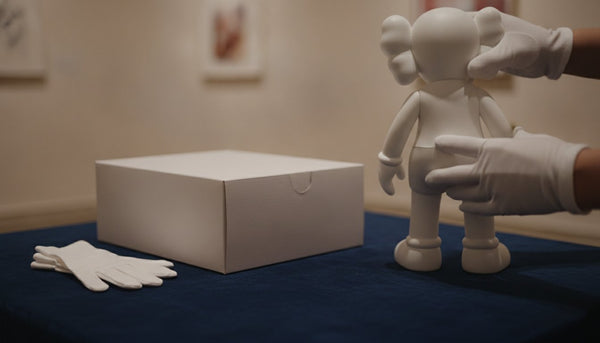
For collectors evaluating OF-era pieces, the highest-confidence purchases come with one or more of: original OF store receipt, complete packaging (outer box, inner sleeve, accessories, hangtags), Medicom Toy production stamp, and chain-of-custody documentation back to a 2006-2013 purchase date. For deeper context on building a KAWS collection across categories, see our KAWS collector guide.
The Permanent Legacy
OriginalFake was the operational expression of a thesis that has since defined Brian Donnelly's career: that contemporary art, designer collectibles, and cultural retail are not separate categories but a single continuous practice. The Aoyama store closed in 2013, but the framework it established — artist-controlled distribution, scarcity engineering, cross-format release cadence — became the template for every major KAWS partnership that followed, from Dior to Uniqlo BFF to AllRightsReserved inflatables.
For collectors, the OF era represents a permanently closed seven-year window of finite production. Every piece is a primary-source artifact of the moment KAWS transitioned from streetwear-adjacent artist to globally collected cultural figure.
Building a KAWS collection? Browse our curated authenticated inventory or contact the Gauntlet Gallery team — founded 2012, with one of the deepest comparative sales datasets in the contemporary collectibles market.