The KAWS Fort Worth exhibition was "Where the End Starts," a major retrospective held at the Modern Art Museum of Fort Worth from October 20, 2016 through January 22, 2017 — the first major US museum solo show dedicated to Brian Donnelly's work, marking the artist's formal entry into American institutional collecting.
Why Fort Worth Mattered
By 2016, KAWS — born Brian Donnelly in Jersey City, New Jersey in 1974 — had spent more than two decades transforming subway-advertisement defacement into one of the most commercially and critically powerful brands in contemporary art. He had been collected by Pharrell Williams and Swizz Beatz, exhibited at Aldrich Contemporary in Connecticut, and toured Asia through the Yuz Foundation and AllRightsReserved. But the United States, where his career began on the streets of Jersey City and Manhattan, had not yet given him a museum-scale solo show.
The Modern Art Museum of Fort Worth — a Tadao Ando-designed institution with a permanent collection that includes Rothko, Warhol, and Anselm Kiefer — broke that pattern. "Where the End Starts" was curated by Andrea Karnes and presented KAWS not as a streetwear figure or designer-toy phenomenon, but as a fine artist worthy of historical retrospective treatment in the same galleries that had previously housed Picasso and Pollock.
The Institutional Validation Thesis
For collectors, Fort Worth was the inflection point that retroactively re-categorized everything KAWS had made since 1996. Pre-Fort Worth, KAWS was a "designer artist" — a category that auction houses approached cautiously. Post-Fort Worth, he was a museum-collected painter and sculptor, and the secondary market re-priced accordingly. Within thirty months of the Fort Worth opening, KAWS would set his auction record of $14.7 million for The KAWS Album at Sotheby's Hong Kong in April 2019.
The Exhibition Itself
"Where the End Starts" was a deliberate historical survey. Rather than focus on the gallery-friendly Companion sculptures or the Uniqlo BFF collaborations that defined KAWS in popular imagination, Karnes built the show around the full arc of Donnelly's practice.
What Was on View
- Early advertisement-defacing work (1993–1999): Original altered bus-shelter ads and phone-booth posters where KAWS overlaid his signature skull-and-crossbones imagery on Calvin Klein, DKNY, and Diesel campaigns. These were displayed under glass — a museological treatment for objects originally meant to be illegal and ephemeral.
- Companion drawings and sketches: Original ink-on-paper development drawings showing the evolution of the Companion character from its 1999 OriginalFake vinyl debut through its sculptural maturity.
- Large-scale paintings: Acrylic-on-canvas works including Along the Way, The Walk Home, and pieces from the CHUM and Accomplice series, demonstrating KAWS' fluency with abstract composition, color theory, and pop appropriation.
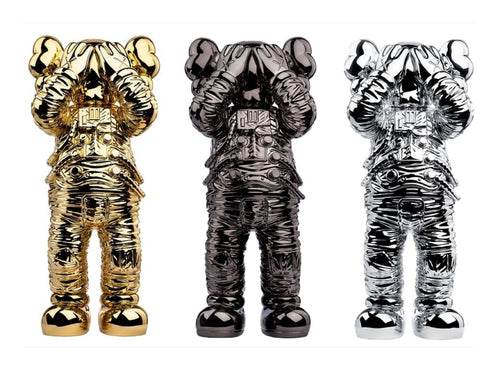
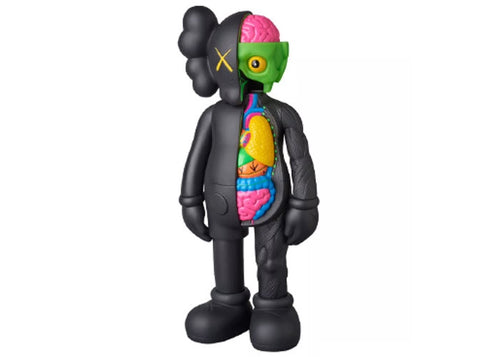
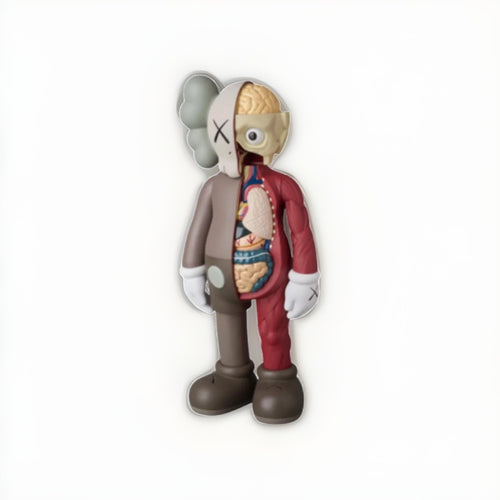
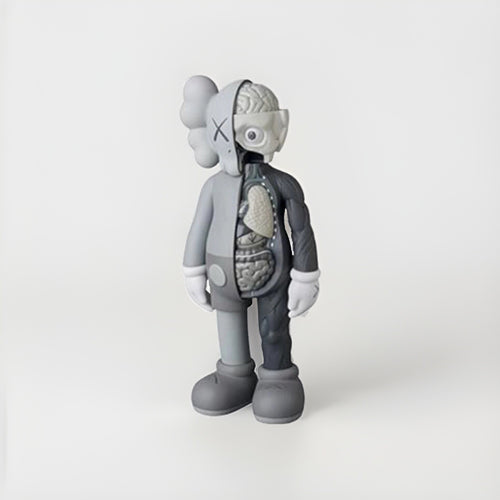
- Sculpture: Large-format Companion and BFF figures in wood, bronze, and fiberglass, including pieces over ten feet tall.
Fort Worth Exhibition Facts
| Detail | Information |
|---|---|
| Exhibition Title | KAWS: Where the End Starts |
| Venue | Modern Art Museum of Fort Worth, Texas |
| Dates | October 20, 2016 – January 22, 2017 |
| Curator | Andrea Karnes, Senior Curator |
| Architect of Venue | Tadao Ando (building completed 2002) |
| Format | Historical retrospective, 1993–2016 |
| Significance | First major US museum solo exhibition for KAWS |
| Subsequent Tour Stop | Yuz Museum, Shanghai (March – August 2017) |
| Artist DOB | Brian Donnelly, born November 4, 1974, Jersey City NJ |
The Yuz Museum Continuation
The "Where the End Starts" title carried forward to the Yuz Museum in Shanghai in spring 2017, where Budi Tek's institution mounted an expanded version of the exhibition. The Shanghai presentation added scale — the Yuz's industrial warehouse allowed larger sculptural installations than Fort Worth's gallery rooms — but the curatorial spine was the Fort Worth show. For the secondary market, this Asia continuation amplified the Fort Worth signal: a US museum had validated KAWS, and Asia's largest private museum had agreed.
Why the Pairing Mattered for Collectors
The Fort Worth-Yuz pairing established what Gauntlet Gallery's 160,000+ comparable sales database now recognizes as a structural pattern in KAWS pricing: institutional bicoastal validation (US museum plus Asia museum) produces a measurable lift across all editions, prints, and figures associated with the artist's pre-2016 catalog. Original advertisement-defacing pieces from the 1993–1999 period — once the most under-collected segment of KAWS' output — saw documented secondary market appreciation in the years following Fort Worth, reflecting their inclusion in a museum-validated historical narrative.
What Fort Worth Changed
For KAWS as an Artist
Fort Worth gave Donnelly the curatorial framing every contemporary artist needs to graduate from "collectible" to "collected." The Modern's institutional authority — and the catalog Karnes produced alongside the exhibition — established the language used by every subsequent museum show, including the Brooklyn Museum's 2021 KAWS: WHAT PARTY survey and the National Gallery of Victoria's 2019 commission. Without Fort Worth, the broader US museum tour does not happen on the same timeline.
For the Secondary Market
Fort Worth re-set the floor for KAWS originals and limited editions across the documented secondary market. Acrylic paintings from the CHUM and Accomplice series, which had traded in private gallery sales prior to 2016, began appearing at Phillips, Sotheby's, and Christie's evening sales with regularity. Companion sculpture editions that had been treated as designer-toy collectibles began to be catalogued as contemporary art. This re-categorization is the central reason a 2019 Sotheby's Hong Kong sale could deliver the $14.7 million result for The KAWS Album.
For Collectors
Fort Worth created a clear before-and-after line in the KAWS catalog. Works exhibited in the Fort Worth retrospective — or in the Yuz continuation — carry exhibition provenance that materially affects valuation. Original Companion sketches and early advertisement-defacing pieces shown in either venue trade at consistent premiums to comparable un-exhibited works in the same period, a pattern reflected in Gauntlet Gallery's comparable sales database.
Authentication Implications
The Fort Worth retrospective also tightened the authentication landscape. With museum-grade provenance documentation now circulating for KAWS' pre-2000 work, the secondary market gained a reference standard for what authentic early KAWS looks like — particularly for the advertisement-defacement pieces that had been the easiest segment to forge. Gauntlet Gallery, founded in 2012, integrates the Fort Worth and Yuz exhibition catalogs into its KAWS authentication research, alongside auction-house condition reports and original gallery documentation.
For collectors building a KAWS position today, understanding the Fort Worth inflection point is foundational. For a deeper framework on building, authenticating, and pricing a KAWS collection, see our KAWS Collector Guide.
Explore Authenticated KAWS at Gauntlet Gallery
Gauntlet Gallery sources, authenticates, and offers KAWS prints, figures, and original works with full provenance documentation grounded in the same museum-validated framework Fort Worth established in 2016. Browse our current KAWS inventory and authenticated contemporary art collection.