Bob Marley - Catch a Fire by Shepard Fairey: Collector Guide, Value & What to Know
The Shepard Fairey Bob Marley - Catch a Fire screen print is one of the most sought-after works in the OBEY Giant music series — and the answer to whether it is worth buying is straightforward: yes, if you can verify the documentation. Produced in the OBEY Giant tradition of limited-edition, hand-pulled screen prints, this piece combines Fairey's unmistakable propaganda-poster aesthetic with one of the most iconic figures in 20th-century music. It holds genuine dual-market appeal — serious art collectors and die-hard reggae and Bob Marley fans both compete for it — which is precisely the condition that creates and sustains long-term value in the secondary market. As long as provenance is intact and the edition is authenticated through OBEY Giant studio records, this is a print with real collector weight behind it.
About Bob Marley - Catch a Fire
Bob Marley is not simply a reggae musician — he is a global symbol of resistance, unity, and spiritual grounding whose influence has outlasted every trend that surrounded him during his lifetime. Born in Jamaica in 1945, Marley brought reggae to international audiences through a series of landmark albums that melded Rastafarian philosophy, political urgency, and deeply personal songwriting. Catch a Fire, released in 1973, was the breakthrough — the first reggae album released as a full artistic statement for a global market, packaged and sequenced like a rock LP. It introduced Marley and the Wailers to audiences beyond Jamaica and launched one of the most consequential careers in popular music history. Marley died in 1981, but his catalog has never stopped growing in stature. He remains one of the most-licensed, most-streamed, and most-recognized musicians on earth, and imagery connected to him carries cross-generational and cross-cultural resonance that very few artists can match.
Shepard Fairey's decision to work with Marley as a subject is not accidental. Fairey has always been drawn to figures whose image has become inseparable from a larger idea — activism, counterculture, defiance. Marley fits that template precisely. The Catch a Fire reference grounds the work in a specific, meaningful moment in Marley's career rather than defaulting to generic iconography. It signals to collectors that this is a considered piece, not a celebrity portrait. Fairey has engaged with musicians throughout his career — from the Rolling Stones to Led Zeppelin to Johnny Cash — and the Marley works sit among the most resonant because the subject's own legacy is so durable. The cultural significance does not fade, and neither does collector demand for prints tied to it.
The Print — What You Are Getting
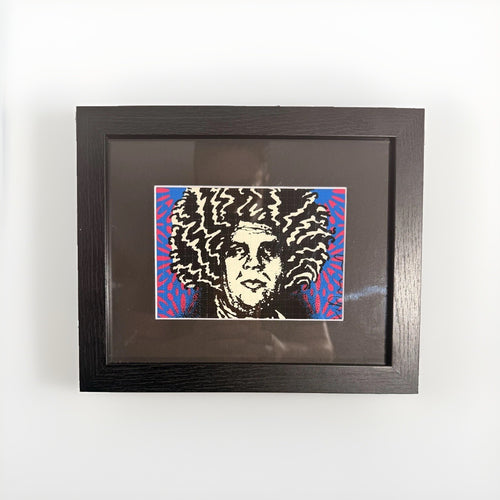
The Bob Marley - Catch a Fire is a screen print produced by the OBEY Giant studio. Standard Fairey music-series screen prints are produced in editions ranging from approximately 150 to 450, with smaller editions commanding stronger secondary-market premiums. The visual language is quintessentially Fairey: bold flat color fields, high-contrast linework, and a graphic sensibility drawn from agitprop and Soviet-era propaganda posters filtered through West Coast street art. The palette tends toward punchy primaries and earth tones, rendered with the precision that OBEY Giant's production team has refined over decades of studio screen printing. Standard dimensions for this series are 18 x 24 inches, which is the canonical Fairey format and fits standard archival framing without custom matting. The print is signed in pencil by Fairey in the lower right, with the edition number hand-inscribed alongside the signature — both indicators of a genuine studio release rather than an unsigned variant or later reprint.
Authentication and Provenance
Authentication for Shepard Fairey screen prints is handled exclusively through OBEY Giant studio documentation. The standard markers on a legitimate studio edition are: a pencil signature by Fairey in the lower right corner; the edition number written in pencil in the format XX/YYY (your number out of the total edition); and the OBEY blind-deboss seal, a tactile embossed stamp pressed into the paper that is difficult to replicate and serves as the studio's primary anti-counterfeiting measure. No third-party certificate of authenticity is required for Fairey works — in fact, OBEY Giant does not recognize external COA issuers as authoritative for its editions. The studio records are the chain of custody. Collectors should also verify the paper stock (Fairey editions use quality archival papers with consistent texture and weight) and examine the print under raking light to confirm the blind-deboss is genuinely pressed rather than printed. If purchasing from a secondary-market source, request documentation of original purchase or prior ownership when available, but understand that the physical markers on the print itself are the definitive authentication standard.
Value in Context
Within Fairey's broader output, music-related works occupy a premium tier. The reason is structural: they carry two distinct collector bases — fine art buyers who follow Fairey's studio practice, and music collectors who want the most significant artistic representation of an artist they love. When both groups compete for the same limited edition, prices reflect that competition. Bob Marley specifically is a cultural anchor subject — a figure whose image generates consistent global demand across age groups and geographies, not a niche or cult subject whose appeal may narrow over time. That distinction matters for long-term value. Fairey prints tied to subjects with universal recognition and enduring cultural weight tend to hold and appreciate more reliably than prints tied to more niche references. The Catch a Fire framing adds additional specificity and seriousness, positioning this as more than a portrait — it is a work rooted in a specific artistic moment that serious music collectors understand and value. For current pricing, contact Gauntlet Gallery directly; the secondary market for this work reflects strong sustained demand.
FAQ
- Is the Shepard Fairey Bob Marley - Catch a Fire print authentic?
- Authentic examples are documented entirely through OBEY Giant studio records. Look for a pencil signature in the lower right, an edition number in the format XX/YYY in pencil, and the OBEY blind-deboss seal. No third-party COA is required or recognized for Fairey's studio editions — the studio documentation is the authentication standard.
- What is the Shepard Fairey Bob Marley - Catch a Fire print worth?
- Music-themed Fairey screen prints with dual collector bases — art collectors and music fans — consistently trade at a premium over single-audience subjects. Standard edition Fairey music prints in strong condition with full documentation typically range from several hundred to several thousand dollars depending on edition size, subject prominence, and current market demand. Contact Gauntlet Gallery for current pricing on this specific work.
- Where can I buy the Shepard Fairey Bob Marley - Catch a Fire print?
- Gauntlet Gallery carries authenticated Shepard Fairey screen prints including music series works. Browse current inventory at https://gauntlet.gallery/collections/shepard-fairey or contact us directly for availability and pricing on the Bob Marley Catch a Fire edition.
For deeper background on Fairey's studio practice, edition structure, and what separates a strong acquisition from a weak one, read our full Shepard Fairey Collector Guide.
Browse all available Shepard Fairey prints at Gauntlet Gallery.