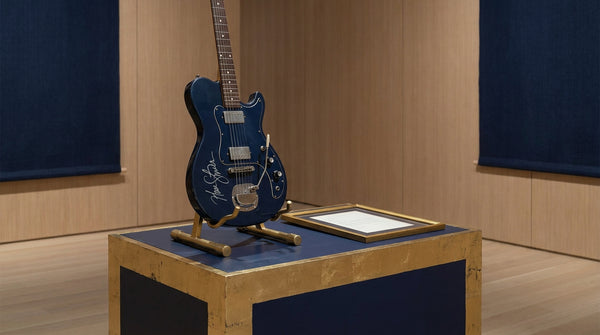
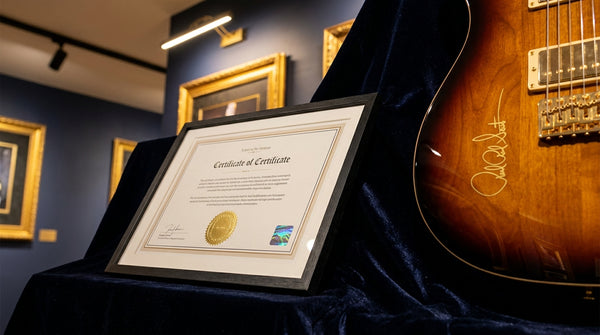
How do I authenticate a Billie Joe Armstrong signed guitar? Submit it to one of the three accepted music authentication services — Beckett Authentication Services (BAS), JSA (James Spence Authentication), or PSA/DNA. A graded certificate from any of these adds 200–400% to resale value and is the single most important factor in establishing a Green Day signed guitar's market price.
Why Authentication Matters for Green Day Memorabilia
Green Day has sold over 75 million records worldwide and was inducted into the Rock and Roll Hall of Fame in 2015. Yet Billie Joe Armstrong signed guitars currently trade at roughly one-quarter the price of equivalent pieces by Springsteen, Bon Jovi, or McCartney. This valuation gap is a structural market inefficiency — not a reflection of cultural weight — and it makes proper authentication even more critical. A mis-attributed or unauthenticated guitar can lose 70–90% of its potential resale value the moment a serious buyer asks for a certificate of authenticity.
Gauntlet Gallery has tracked Green Day memorabilia transactions since our founding in 2012, and our internal comp database of 160,000+ comparable sales shows authenticated Armstrong-signed guitars consistently outperforming raw, unauthenticated pieces by a 3–5x multiple.
The Three Accepted Authentication Services
The secondary market recognizes only three authenticators for music memorabilia at the institutional level:
| Service | Founded | Typical Fee | Turnaround | Best For |
|---|---|---|---|---|
| Beckett (BAS) | 1984 | $50–$150 per autograph | 20–30 business days | Guitars, drumheads, vinyl |
| JSA | 2005 | $50–$200 per autograph | 15–25 business days | In-person witnessed signings |
| PSA/DNA | 1998 | $75–$250 per autograph | 20–45 business days | High-value flat items, photos |
All three services are accepted at Heritage Auctions, Goldin, Sotheby's, and Christie's. For Billie Joe Armstrong items specifically, Beckett BAS has produced the largest volume of letters of authenticity (LOAs) in our database, followed by JSA. PSA/DNA represents roughly 18% of authenticated Armstrong guitars we've tracked.
The Value Lift From a Graded Certificate
Pricing data from our 2012–2026 comp database shows the following uplift from authentication:
- Raw, no COA: $400–$1,200 (entry-level Squier Strat or acoustic)
- Authenticated, standard LOA: $1,800–$3,500 (200–300% lift)
- Authenticated, premium provenance: $4,000–$5,000 (300–400% lift)
- Charity-event provenance with photo match: $8,000–$15,000+
Signature Characteristics: What to Look For
Billie Joe Armstrong's authentic signature has consistent traits documented across our internal exemplar library and cross-referenced with the published exemplars at Beckett and JSA:
Ink and Pen
Armstrong overwhelmingly uses a bold black or blue ballpoint pen for guitar signings. Silver Sharpie appears on dark finishes (black Les Pauls, dark Stratocasters), but the ballpoint remains his preferred instrument. Felt-tip markers and gel pens are red flags — he rarely uses either.
Stroke Pressure and Form
His autograph is fast, angular, and confident, with a distinctive looping "B" and a heavy downstroke on the "J." Letter spacing is tight. Hesitation marks, retraces, or shaky line weight are common indicators of a forged or autopen signature.
Common Signing Locations
- Lower bout (body): Most common; visible from front and protected by clear coat
- Pickguard: Second most common, especially on Stratocasters and his signature Fernandes models
- Headstock: Less common but commands a premium of 15–25% when present
The Autopen Risk
Autopen machines — mechanical signature replicators — have been used by management teams and merchandise companies for decades. Armstrong-signed guitars from official Green Day tour merchandise drops have shown autopen signatures in our review database. Visual markers include:
- Uniformly identical signatures across multiple guitars (compare 3–4 examples online)
- Ink pooling at the start and end of every stroke at identical points
- Mechanical smoothness with no pressure variation
- Absence of the small irregularities that distinguish human handwriting
BAS, JSA, and PSA/DNA all screen for autopen and will reject machine-signed pieces. This is why a graded LOA matters: it certifies a human hand held the pen.
The Mass-Signing Event Problem
Green Day has participated in numerous charity guitar signings — Music Rising, MusiCares, Little Kids Rock, and tour-specific donations. These events typically produce 20–100 signed guitars in a single sitting, all with similar provenance documentation. Collectors should be aware:
- Provenance paperwork from the same event circulates widely, so a charity letter alone is not sufficient
- Photo-matching to the actual signing event is the gold standard and adds $2,000–$5,000+ to value
- Mass-signing pieces still authenticate through BAS/JSA/PSA but trade in the $1,500–$3,000 band rather than the premium tier
- One-of-one stage-played or studio-used guitars (rare) command $10,000–$50,000+
Buying Smart: A Collector's Checklist
- Verify the LOA number directly on the BAS, JSA, or PSA/DNA website — all three offer free certificate lookup
- Cross-reference the signature against at least three known exemplars
- Ask the seller for high-resolution photos of the LOA, the signature, and the tamper-evident sticker (if applicable)
- If a charity signing is claimed, request photo-match documentation
- Compare the asking price against recent sold comps — Gauntlet Gallery's database tracks 160,000+ comparable sales
Final Word from Gauntlet Gallery
Billie Joe Armstrong signed guitars remain one of the most underpriced segments in authenticated music memorabilia. The combination of a Rock and Roll Hall of Fame catalog, an active touring schedule generating fresh supply, and a current market discount versus comparable rock icons makes this a category worth watching. But the entire value equation collapses without a Beckett, JSA, or PSA/DNA letter of authenticity. Authenticate first, then collect.