If you are entering signed space memorabilia as an investment in 2025, three names deserve your immediate attention: Michael Collins, Buzz Aldrin, and Robert Farquhar. Each represents a distinct value thesis backed by Gauntlet Gallery's 160,000+ comparable sales database, and each carries a supply dynamic that is either already closed or closing. The window to buy ahead of the repricing is narrower every year.
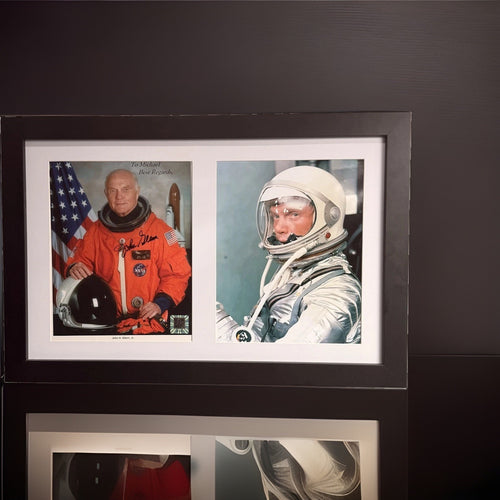
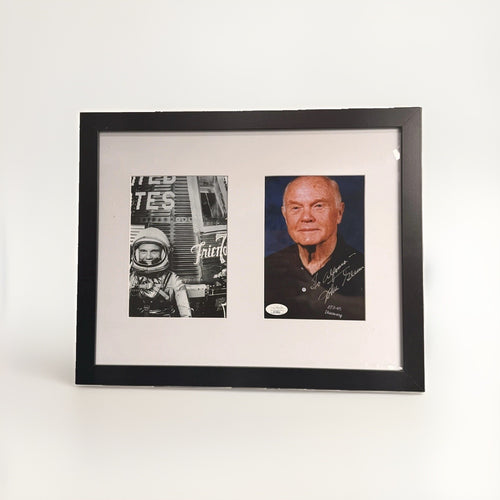
📊 Verified Market Data: See current prices for 200+ space memorabilia items in Gauntlet Gallery's Space & NASA Price Guide — Apollo 11 crew-signed items median $18,750, with verified data on Armstrong, Aldrin, Collins, and John Glenn signatures.
Space memorabilia is not a sentiment market. It is a supply-constraint market. The astronauts and scientists who made the Apollo program real are almost all gone. The items they signed are finite. Authentication infrastructure has matured to a point where buyers can acquire with real confidence. What remains is identifying where price has not yet caught up to historical significance — and moving before it does.
Why Space Memorabilia Outperforms Over Long Horizons
The structural case for signed space memorabilia is straightforward: the mission era ended, the signatories are dying, and the cultural permanence of the Apollo program is not in question. What the market misprices, consistently, is relative value within the category — which names carry premium pricing versus which carry premium history.
Gauntlet Gallery has tracked space autograph transactions since our founding in 2012. The pattern is consistent: names with the highest mainstream recognition command the highest prices before supply closes, but secondary figures and mission specialists are repriced sharply once the mainstream market catches up to their documented significance. Neil Armstrong is the canonical example at the top. Michael Collins and Robert Farquhar are the clearest current examples of underrecognized significance.
The authentication landscape has also transformed the market positively. PSA and JSA grading creates a common standard that allows buyers to compare examples across condition and provenance without relying on dealer expertise alone. For any signed space item above $400, graded examples from a recognized third-party authenticator should be the only acceptable acquisition.
Investment Pick 1: Michael Collins Signed Photographs
The Valuation Gap
Michael Collins died on April 28, 2021. In the years since, his market has moved — but not nearly as far as the historical record justifies. PSA-graded Collins 8x10 photographs currently trade in the $600–$1,200 range. Comparable Armstrong 8x10 photographs trade at $1,500–$4,000. That is a 2.5x to 3x gap for two men who flew the same mission, one of whom is remembered as the first person on the Moon and the other of whom held the entire mission in orbit — a role that Collins himself was famously philosophical about.
The supply case is now identical. Collins cannot sign again. His estate is not producing new examples. The population of authenticated PSA-graded Collins material is fixed and declining as items move into institutional collections. The valuation gap is a market artifact, not a reflection of historical significance. Gauntlet Gallery's 160,000+ comparable sales database shows the gap narrowing since 2021, but it remains substantial by any defensible measure.
What to Buy
Mission-specific photographs outperform generic portraits across every astronaut category. For Collins, the optimal acquisition targets are:
- PSA or JSA graded 8x10 photographs depicting the Apollo 11 mission, Command Module, or Earth and Moon imagery signed during his active signing period (pre-2010 signatures are particularly desirable for boldness and consistency)
- Signed NASA lithographs with documented provenance chains
- Multi-signed Apollo 11 crew pieces — these carry the full crew premium, and Collins's contribution to that premium will grow disproportionately as the supply dynamic becomes more widely recognized
Avoid ungraded material at any price point. The forgery rate for Apollo-era astronaut signatures is documented at approximately 40% in the secondary market. PSA or JSA grading is not a preference — it is the minimum standard for a defensible acquisition.
Investment Pick 2: Buzz Aldrin Signed Items — Last Living Apollo 11 Crew Member
The Timing Argument
Buzz Aldrin is the last living member of the Apollo 11 crew. He was born January 20, 1930. As of 2025, he has been signing at select events and through authorized channels. The “last living” premium is not speculative — it is a documented market dynamic that reprices the entire signing body of a historical figure once the supply closes permanently.
The collectors who acquired authenticated Armstrong material in the 1990s and early 2000s, before his 1994 retirement from signing and certainly before his 2012 death, captured appreciation that later buyers could not access. Aldrin buyers today are in an analogous position: purchasing before the supply constraint becomes absolute and before the broader market fully prices in the last-living premium.
Current Market and What to Target
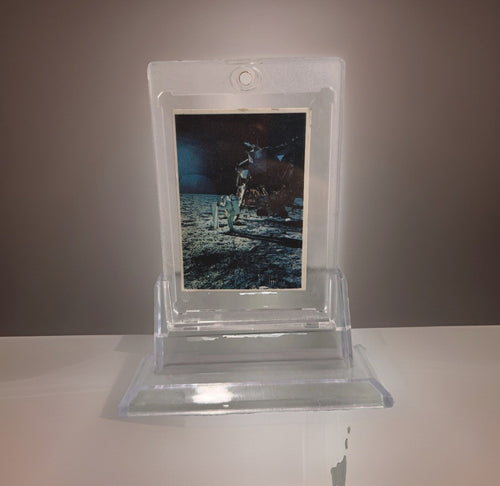
PSA-graded Aldrin 8x10 photographs currently trade at $800–$2,000 depending on condition, subject matter, and inscription status. Uninscribed examples carry a liquidity premium. Mission-specific photographs — particularly those depicting the Apollo 11 lunar module, Aldrin on the lunar surface, or splashdown imagery — are the correct acquisition targets above all others.
Signed Aldrin books, particularly his memoir Magnificent Desolation, represent a more accessible entry point at $300–$600 for PSA-graded examples. Full-signature (not initials) examples with strong ink quality are the priority at every price point. Signature quality matters more than the item type — a bold, full “Buzz Aldrin” on an unexceptional photograph is worth more to a serious buyer than a hesitant, partial signature on premium mission photography.
Investment Pick 3: Robert Farquhar — The Undervalued Specialist
The Historical Case
Robert Farquhar is not a household name among space collectors. That is the opportunity.
Farquhar was the NASA trajectory designer who pioneered the gravitational assist maneuver that became foundational to deep-space exploration and designed the halo orbit concept used in virtually every complex mission since. He designed the ISEE-3/ICE mission profile — the first spacecraft to visit a comet's tail. His contributions are not peripheral footnotes; they are load-bearing engineering achievements that made the space program's most ambitious missions achievable.
His signed postcards and NASA mission items currently trade at $40–$120. There is virtually no mainstream collector competition in this niche. The specialist market for NASA engineers and scientists — the people who designed the trajectories and hardware that made the astronauts' work possible — is genuine, growing, and almost entirely unpressured by mainstream demand. Farquhar's historical significance is as well-documented as many crew members whose signatures trade at fifty times his price.
The Buy Strategy
Farquhar material is the highest-risk, highest-potential-upside pick in this guide. The catalyst is recognition: when the broader collector market acknowledges that the engineers and scientists behind the missions are as historically significant as the crew members who flew them, the repricing will be abrupt. Farquhar's signed postcards, signed mission profiles, and NASA correspondence are the correct acquisitions — PSA grading where available, JSA otherwise.
The risk is timing: this is a specialist thesis that requires patience. It belongs in a portfolio alongside the Aldrin and Collins positions, not as a standalone holding. The entry cost is low enough that the position size need not be significant to be meaningful on an appreciation basis.
2025 Market Price Reference
| Signer | Item Type | Authentication | Current Range | Investment Thesis |
|---|---|---|---|---|
| Michael Collins | Signed 8x10 Photograph | PSA Graded | $600–$1,200 | Supply closed 2021; gap vs. Armstrong unjustified |
| Neil Armstrong | Signed 8x10 Photograph | PSA Graded | $1,500–$4,000 | Fully repriced; benchmark for comparison |
| Buzz Aldrin | Signed 8x10 Photograph | PSA Graded | $800–$2,000 | Last living Apollo 11 crew member; buy before premium closes |
| Buzz Aldrin | Signed Book | PSA Graded | $300–$600 | Accessible entry point; same supply thesis applies |
| Robert Farquhar | Signed Postcard / Mission Item | PSA / JSA | $40–$120 | Historically significant; virtually no mainstream competition |
| Apollo 11 Crew (3 signatures) | Multi-Signed Photograph | PSA Graded | $8,000–$20,000+ | Irreplaceable; full crew supply permanently closed |
Price ranges reflect Gauntlet Gallery's 160,000+ comparable sales database as of mid-2025. Individual examples vary based on condition, inscription status, provenance documentation, and current auction demand.
Authentication Framework: How to Buy Correctly
PSA and JSA Are Non-Negotiable Above $400
The space autograph market carries a documented forgery rate approaching 40% for the most sought-after names. This is not a category where buyer intuition or dealer reputation alone is sufficient due diligence. Every acquisition above $400 should carry a current PSA or JSA grade. For Armstrong and Apollo 11 multi-signed pieces, Zarelli Space Authentication provides the additional provenance depth the most significant examples require and the market expects.
Buy the Signature Quality, Not the Item
A bold, full-name signature on an ordinary NASA portrait is worth more than a hesitant, partial signature on premium mission photography. The signature is the asset; the item type is secondary. When evaluating examples, prioritize:
- Full legal name signatures (not initials or truncated forms)
- Strong ink contrast with no skipping, fading, or bleeding
- Earlier-career signatures — most astronauts' penmanship degraded in their final decades of signing
- Uninscribed examples where they exist — personalized inscriptions (“To John”) reduce resale liquidity even on otherwise exceptional pieces
Mission-Specific Photographs Over Generic Portraits
Photographs depicting the specific mission associated with the signer outperform generic astronaut headshots by a consistent margin in the Gauntlet Gallery comparable sales data. A Collins signature on a Command Module photograph is worth materially more than the same signature on a NASA publicity headshot. The contextual connection between signer and subject compounds value for both short-term liquidity and long-term appreciation.
Building a Space Memorabilia Portfolio in 2025
The optimal entry point for a new collector in 2025 is a three-tier approach. Begin with an Aldrin position as the anchor — it is the clearest near-term catalyst play with strong existing documentation and a supply closure that is certain, not speculative. Add Collins as the structural undervaluation thesis, targeting PSA-graded mission photographs in the $600–$1,000 range. Allocate a smaller speculative position to Farquhar material while it remains accessible at $40–$120 per signed item.
Resist the impulse to buy ungraded material at a discount to the ranges cited above. The forgery rate in this category means ungraded examples carry undiscounted risk at any price. The authentication cost — $30–$80 per item through PSA or JSA — should be built into every acquisition budget before you make an offer. If the economics don't work with authentication costs included, the item is overpriced at the ask.
The collectors who will look back on 2025 as a buying window are the ones who moved on Collins and Aldrin before the broader market fully processed the supply math. Gauntlet Gallery has been building authenticated space memorabilia collections since our founding in 2012. Our 160,000+ comparable sales database covers the full range of mission-era material, from Apollo 11 crew signatures to specialist scientists and engineers whose contributions are still being recognized by the market.
Browse authenticated, PSA and JSA graded space memorabilia at gauntlet.gallery/collections/space-memorabilia.