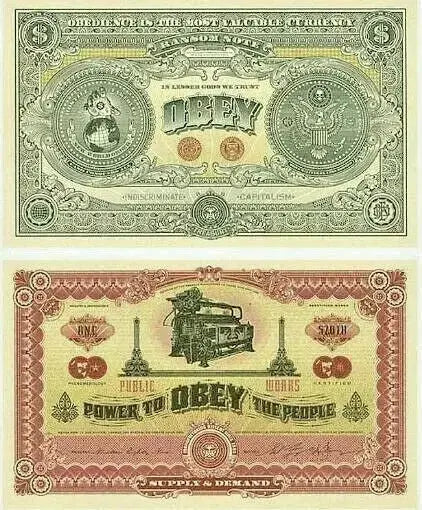
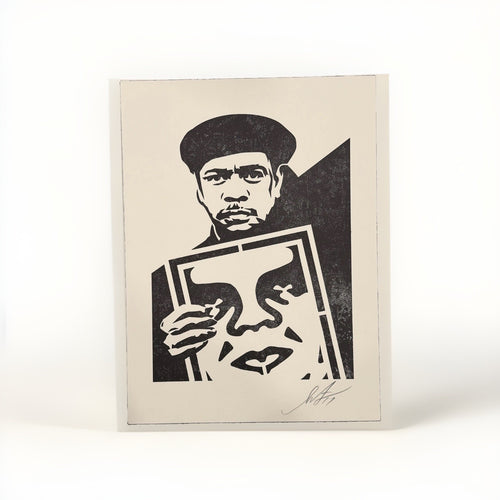
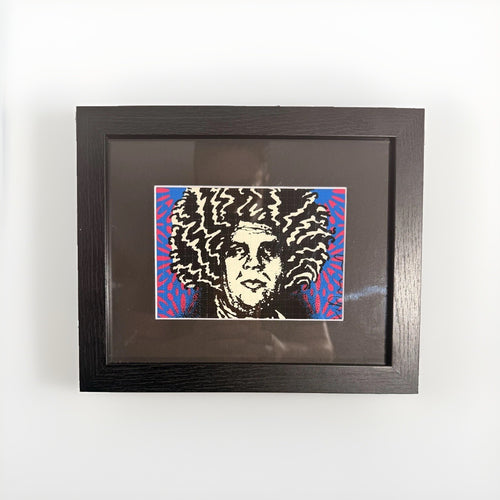
Shepard Fairey created the first Andre the Giant sticker in 1989 at the Rhode Island School of Design on a dare from a friend. He drew Andre Rene Roussimoff — the 7-foot-4-inch, 520-pound professional wrestler — photocopied the image onto adhesive paper, and scrawled invented stats alongside the words "Andre the Giant Has a Posse." What Fairey intended as a five-minute prank became the most consequential act of American street art in the 20th century, ultimately producing a global brand, a $950,000 auction record, and a generation of collectors who can't stop chasing the originals.
Providence, 1989: A Dare That Changed Street Art
Fairey was a 19-year-old student at RISD when a friend showed him how to make stickers from photocopied images. The technique was trivially simple — draw something, run it through a Xerox machine onto peel-and-stick paper, and you had an infinitely reproducible mark you could put anywhere. The choice of subject was accidental. Andre the Giant's face appeared in a newspaper Fairey had at hand. The proportions — the square jaw, the massive brow, the eyes set wide — translated perfectly into high-contrast black-and-white graphic reproduction.
The first run was tiny: a few dozen stickers placed on lamp posts, dumpsters, and skate ramps around Providence. But Fairey understood something intuitively that he would later articulate through Situationist theory: a strange, unexplained image, repeated relentlessly, forces people to question why it exists. There was no product. No cause. No band promoting a tour. Just a giant face and a nonsensical phrase. People stopped. They asked questions. The sticker became a conversation about the nature of authority and advertising simply by being unexplainable.
The Situationist Engine: Phenomenology as Street Art
Fairey arrived at RISD already interested in punk and skate culture, both of which carried a DIY ethic that pushed back against mass media. But it was his encounter with Situationist International theory — particularly the writings of Guy Debord and the concept of the détournement — that gave his sticker campaign an intellectual framework.
The Situationists believed that late capitalism had reduced everyday life to a passive spectacle. Their response was to hijack that spectacle — to insert images and interventions into the commercial landscape that disrupted its logic without offering a replacement. Fairey's Andre sticker was a perfect Situationist object: it used the visual language of advertising (repetition, bold graphics, ubiquitous placement) to deliver nothing. No purchase was possible. No ideology was on offer. The image simply was, demanding you decide what it meant.
Fairey formalized this in what he called his "phenomenological experiment" — a deliberate test of whether a meaningless image, repeated at sufficient scale, could develop cultural gravity from pure presence. The answer, across 35 years of evidence, is an unambiguous yes.
City by City: How the Campaign Spread
The sticker's spread followed skate culture's informal distribution networks. RISD students carried stickers to their home cities during breaks. Skaters traded them the way they traded zines and cassette tapes. By 1990, Andre faces had appeared in Boston, New York, Washington D.C., and Los Angeles. By 1993, they were in Europe and Australia.
The mechanics of the spread were pre-internet but surprisingly efficient. Fairey printed templates and encouraged anyone who wanted to participate to make their own stickers and wheatpaste posters. The campaign was open-source before that term existed. This decentralization meant Fairey couldn't control quality or placement, but it also meant the image was everywhere — and everywhere it appeared, it generated the same slightly unsettled curiosity.
By the mid-1990s, mainstream media had noticed. Articles in alternative weeklies, then in national magazines, tried to explain the phenomenon. Each article amplified it further. Fairey had achieved the Situationist goal: he had hijacked the spectacle using the spectacle's own tools.
WWF Legal Pressure and the Birth of OBEY GIANT
Andre Rene Roussimoff died in January 1993. The World Wrestling Federation, which held rights to his wrestling persona, began paying closer attention to how his likeness was being used commercially. As Fairey's sticker campaign spread nationally and gained media coverage, legal pressure arrived in the form of cease-and-desist demands.
Fairey's response was strategically brilliant. Rather than fight the trademark claims or abandon the campaign, he abstracted the image. He cropped the portrait tighter, flattened the likeness into a bold graphic mark, and replaced "Andre the Giant Has a Posse" with "OBEY GIANT." The word "OBEY" — a direct Situationist provocation, instructing the viewer to comply with nothing — was more confrontational and more memorable than the original phrase. The legal pressure had forced a design evolution that produced a stronger mark.
The transition happened roughly between 1995 and 1997. Works bearing the original "Andre the Giant Has a Posse" text, particularly pre-1995 pieces, predate the legal intervention and represent a distinct, unrepeatable chapter of the campaign's history.
Pre-2000 Andre Stickers: Why They Are Museum-Grade Rarities
The original Andre stickers were produced in small quantities — typically a few hundred per run — on standard photocopier paper with adhesive backing. They were not made to last. They were made to be plastered on surfaces in rain, sun, and urban grime, and most were. The survival rate for pre-2000 original stickers in collectible condition is extremely low.
Three factors compound their rarity:
- Material fragility: Photocopy paper and basic adhesive were never archival. Moisture, UV exposure, and physical damage destroyed the vast majority within years of placement.
- The legal transition: The shift to OBEY GIANT branding created a clear before/after break. Pre-transition works are categorically distinct from all post-1997 production.
- Undocumented production: Fairey did not catalog early sticker runs with edition numbers or certificates. Provenance must be established through documentation of acquisition context, photographic evidence of original placement, or chain of custody from known collections.
For collectors, this means pre-2000 Andre-era works function less like standard edition prints and more like artist proofs or unique works — each piece is an artifact, not a numbered multiple.
Fairey Print Market: Tier Reference
Understanding where a work sits in Fairey's production hierarchy is essential for pricing and authentication. Gauntlet Gallery's 160,000+ comparable sales database supports the following tier benchmarks as of mid-2026:
| Tier | Description | Typical Edition Size | 2025–2026 Price Range (Signed) |
|---|---|---|---|
| Standard Screen Print | Single or two-color, standard paper | 450–700 | $300–$800 |
| Deluxe / Heavy Stock | Thick French Paper, richer inks | 100–200 | $800–$2,500 |
| Artist Proof (AP) | Outside main edition, marked AP | 10–50 | $1,500–$5,000 |
| HPM (Hand-Painted Multiple) | Screen print with unique hand-painted elements | 1–10 | $8,000–$45,000 |
| Pre-2000 Andre-Era Works | Original stickers, early posters, pre-OBEY transition | Undocumented / unique | $5,000–$50,000+ |
Authentication: What Every Collector Needs to Know
The forgery rate for Fairey works in online marketplace listings is estimated at approximately 30%. The most common forgeries target the mid-tier signed screen prints where the price point ($400–$1,200) is high enough to motivate fraud but low enough that buyers may skip rigorous authentication steps.
What Authentic Fairey Prints Show
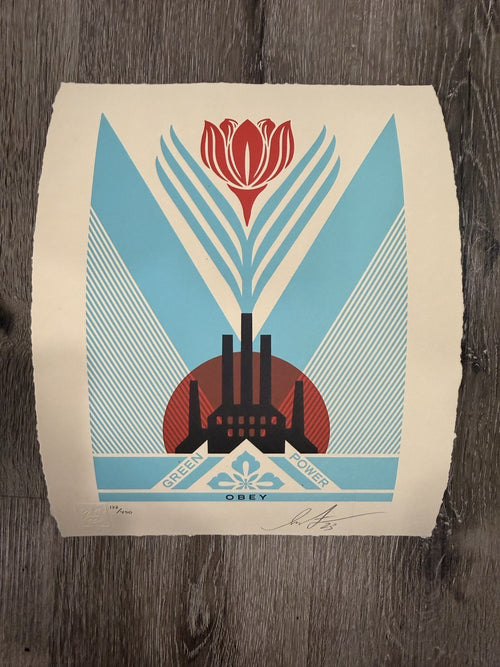
- Hand-signed pencil signature in the lower right margin — never stamped, never reproduced in ink
- Pencil edition number in the lower left (e.g., 147/450)
- Certificate of authenticity from Obey Giant Art for editions published after 2004
- Sharp screen-print registration — color layers align precisely; bleed or blur at layer edges indicates a digital reproduction
- Period-correct paper stock — Fairey's paper suppliers and weights changed over time; a post-2010 paper on a "2002" print is an immediate red flag
Gauntlet Gallery was founded in 2012 specifically to bring provenance-grade authentication standards to the street art print market. Every Fairey work in our inventory is evaluated against archive records and our 160,000+ comparable sales database before pricing or listing.
For a complete walkthrough of authentication standards across all Fairey tiers and editions, see our full Shepard Fairey Collector Guide.
From Providence to the Smithsonian: The Long Arc
The OBEY GIANT campaign's trajectory — from photocopied stickers on RISD-area lamp posts to permanent collection at the Smithsonian National Portrait Gallery — is without precedent in American street art. The 2008 Barack Obama HOPE portrait, which Fairey created for the presidential campaign using an AP wire photograph, reset price floors across his entire catalog and brought institutional museum placement that had previously eluded street-art practitioners entirely.
Three original HOPE collages exist. One is in the Smithsonian's permanent collection. One sold at Heritage Auctions in 2022 for $735,000. The third sold at Santa Monica Auctions in 2023 for $950,000 — Fairey's current auction record. Each escalating sale lifts comp values across the entire post-2008 catalog, creating a structural price floor for authenticated signed editions that has never retreated.
The 1989 dare at RISD set all of this in motion. A photocopied face on adhesive paper, pasted on a Providence dumpster, launched one of the most consequential artistic careers in contemporary street art. The early works that survived that era — scraped off walls, traded between skaters, preserved through decades of inadvertent archiving — are now the rarest artifacts in that story.
Ready to add an authenticated Shepard Fairey work to your collection? Browse our current inventory of signed screen prints, deluxe editions, and HPMs — every piece verified and provenance-matched. Shop Shepard Fairey at Gauntlet Gallery →