

Gauntlet Gallery — Invader Print Index
Rubik Abbey Road
Work Summary & Collector Notes
Released in 2009 through Jonathan LeVine Gallery, Rubik Abbey Road reworks the Beatles' iconic zebra-crossing photograph entirely from Rubik's Cube facelets. Printed as a 7-color giclée on 350 g/m2 matte paper at 50 x 50 cm, the edition of 50 is signed and numbered. It sits squarely in Invader's Rubikcubism practice, translating a pop-culture touchstone into a grid of primary-colored squares.
Collector notes: Edition of 50 plus 8 artist's proofs, 2 hors commerce proofs and 1 printer's proof. Signed, dated and numbered.
Why It Matters
The piece marries two of the most recognizable images in modern culture: the Abbey Road crossing and the Rubik's Cube. By rebuilding a photographic memory from a fixed palette of cube colors, Invader tests how few pixels the eye needs to recognize an icon. Its LeVine Gallery release also anchors it to Invader's key period of U.S. exhibition activity.
Collector Perspective
At an edition of 50, this is one of Invader's tighter Rubikcubism print runs, and the subject gives it crossover appeal beyond street-art circles into Beatles and music-memorabilia collecting. Signed-and-numbered status and the heavyweight 350 g/m2 stock support long-term condition. Collectors should confirm the number, signature, and sheet dimensions against the documented 50 x 50 cm format.
Historical Context
Invader says the 2009 Top 10 exhibition translated ten favorite album covers into Rubikcubism. The square album format suited the six-color, low-resolution method; Rubik Abbey Road belongs to that Rubik Low Fidelity group.
Documented Release Details
- Object type
- Editioned print
- Release date
- 2009-07-03
- Release-date note
- Catalog-listed release date; verify against the original publisher record when available.
- Catalogue reference
- Control P catalogue raisonné no. 15, pp. 74–75
- Series
- Top 10 / Rubik Low Fidelity
- Medium and materials
- Seven-color screenprint; 50 × 50 cm.
- Edition details
- Edition of 50 plus 8 artist's proofs, 2 hors commerce proofs and 1 printer's proof.
- Signature and marks
- Signed, dated and numbered.
Documented History and Meaning
History note: Invader says Top 10 translated ten favorite album covers into Rubikcubism; the album-cover square format suited the method.
Meaning / interpretation: The work references the Beatles' Abbey Road cover. The Beatles are source imagery, not collaborators on the edition. This interpretive note follows the cited artist or publisher context.
Release context: Published by the artist for the 2009 Top 10 exhibition at Jonathan LeVine Gallery, New York.
Authentication, Presentation and Provenance
- Original presentation
- Original packaging or presentation not independently documented in the sources reviewed.
- Authentication note
- Compare the physical example with the documented signature, numbering, printer/publisher marks, dimensions, support and edition structure. A matching number or seller-issued certificate alone does not authenticate a copy.
- Provenance note
- Edition origin is attributed to Jonathan LeVine Gallery. Copy-level provenance is separate: retain invoices, labels, prior ownership records and condition photographs for the specific example.
Related Artists and Exhibitions
- Top 10 — Jonathan LeVine Gallery, New York · 2009 · Edition published for the exhibition
- Invader Rubikcubist — MIMA Museum, Brussels · 2022–2023 · Later museum context for the Rubikcubism series; not proof this impression was exhibited
Sources and Verification
Verification status: Catalogue-backed with primary artist series context
- Rubikcubism — Invader studio · primary artist source · Accessed 2026-07-11 · Artist-authored history of Rubikcubism and the Top 10 / Rubik Low Fidelity series.
- INVADER: Prints on Paper — International Centre of Graphic Arts (MGLC) · museum / catalogue context · Accessed 2026-07-11 · Museum record for the exhibition and 2001–2020 prints-on-paper catalogue raisonné; not an individual-copy certificate.
Known conflicts or unresolved points:
- The legacy release record called the work a giclée; the catalogue-backed record identifies a seven-color screenprint.
FAQ
What is the medium?
The catalogue-backed record identifies a seven-color screenprint, not a giclée.
What is the full edition?
50 regular impressions plus 8 AP, 2 HC and 1 PP.
Were the Beatles collaborators?
No. The work reinterprets the Abbey Road cover as source imagery; the Beatles did not co-author the edition.
Related Invader Works


Shop Invader at Gauntlet Gallery
Live listings with authentication, provenance and documentation.
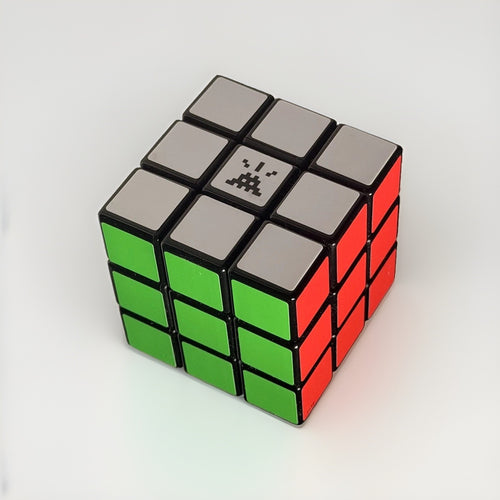
Space Invader x Rubik's Cube RubikCubiste MIMA 2022 Limited Edition Boxed
$185.00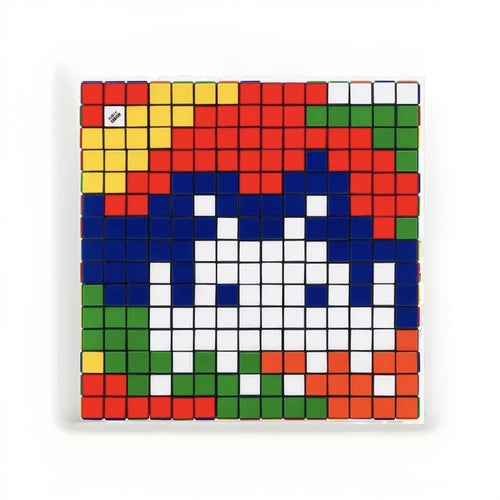
Invader Rubik Camouflage HENI Signed & Numbered 196/812 Giclee Panel 2023
$3,999.00Be first when new Invader pieces drop
You're on the list ✓ — first look at every new Invader arrival.
Shop Invader
Explore current pieces available from the gallery.
-

Space Invader x Rubik's Cube RubikCubiste MIMA 2022 Limited Edition Boxed
$185.00 USD
-
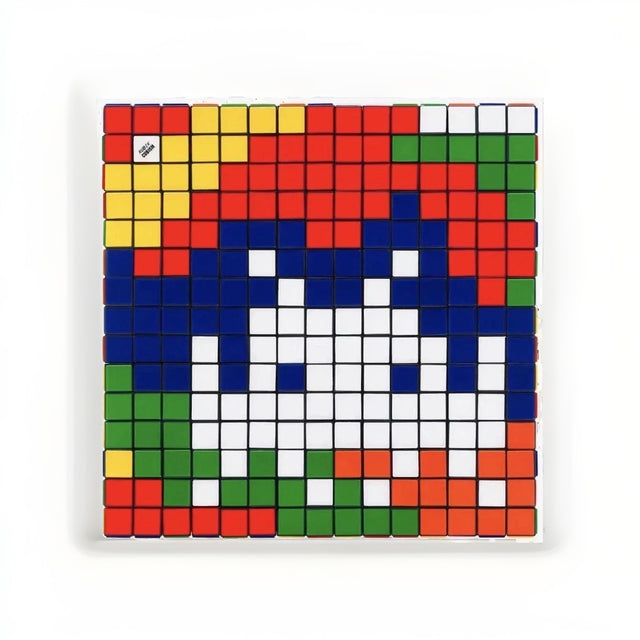
Invader Rubik Camouflage HENI Signed & Numbered 196/812 Giclee Panel 2023
$3,999.00 USD

Browse the collection for current listings.