This NASA First Halo Orbiter PostCard bears the handwritten signature of Robert W. Farquhar — the mission designer who invented the concept of halo orbits and reshaped how humanity navigates deep space. Unlike crew autographs that commemorate a ride to orbit, Farquhar's signature represents intellectual authorship: he is the reason the spacecraft got there at all. For collectors who prize historical depth over celebrity, this piece stands apart from virtually any other NASA artifact on the market. Items in excellent condition authenticated to Farquhar are among the most undervalued space-history collectibles available today.
📊 Verified Market Data: See current prices for 200+ space memorabilia items in Gauntlet Gallery's Space & NASA Price Guide — Apollo 11 crew-signed items median $18,750, with verified data on Armstrong, Aldrin, Collins, and John Glenn signatures.
About Robert Farquhar
Robert W. Farquhar (1932–2015) spent more than four decades at NASA's Goddard Space Flight Center doing something no one had done before — engineering spacecraft trajectories that exploited gravitational interactions between multiple celestial bodies. In the late 1960s he published the doctoral and applied research that defined halo orbits: stable, three-body paths near the Earth–Moon Lagrange points that no Newtonian two-body equation could describe. That work was not abstract; it became operational mission architecture that NASA still relies on today, most visibly in the placement of the James Webb Space Telescope at L2.
Farquhar went on to design or direct missions that each produced a "first" in planetary science. As Flight Director for ISEE-3/ICE, he repurposed an aging solar-wind monitor into the world's first comet-encounter spacecraft — executing a slingshot through the Moon's gravity well in 1983 that engineers at the time called impossible. He then led NEAR Shoemaker, the first spacecraft to orbit and land on an asteroid (433 Eros, 2001). He later served as Mission Director for CONTOUR, designed to intercept two comets. Farquhar received NASA's Exceptional Scientific Achievement Medal and was inducted into the Space Technology Hall of Fame, yet he remained far less known outside the astrodynamics community than astronauts whose missions he made possible. His signature on this postcard is a direct link to that largely unheralded legacy.
About This Specific Item
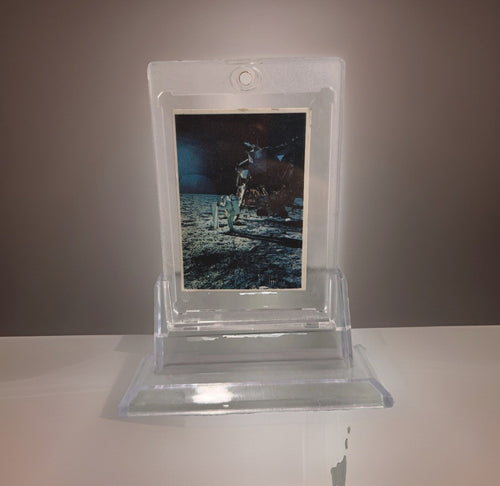
The First Halo Orbiter PostCard is an official NASA commemorative piece issued to mark the milestone of the first spacecraft placed into a halo orbit — a trajectory class that Farquhar himself invented. The card depicts imagery associated with that historic mission and was produced as a keepsake for the space-enthusiast community and the scientific institutions involved in early Lagrange-point exploration. Farquhar's autograph is placed cleanly on the card face, connecting the commemorative image directly to the man whose mathematics made the mission architecture possible.
The context encoded in a single signed postcard like this is substantial. Halo orbits are not a footnote; they are the backbone of every modern L1 and L2 mission, including SOHO, WMAP, and the James Webb Space Telescope. Owning a piece signed by the man who derived that framework — on a card specifically commemorating the first operational use of that framework — is the kind of provenance alignment that rarely occurs in any collecting category. This is not a crew portrait or a launch-day photograph. It is a mission designer's autograph on a mission-specific commemorative, making it historically precise and deeply meaningful to the arc of spaceflight engineering.
Rarity and Scarcity
Robert Farquhar signed relatively little over the course of his career compared to astronauts who routinely worked the convention and mail-signing circuit. As a behind-the-scenes mission architect rather than a public-facing crew member, he had fewer occasions and less institutional pressure to sign memorabilia at scale. His passing in 2015 permanently closed the supply of new authentic signatures, and the pool of PSA- or JSA-graded Farquhar items that enter the market in any given year is extremely small — typically in the single digits across all auction platforms combined.
That scarcity is compounded by the specificity of this item. The First Halo Orbiter PostCard was not mass-distributed consumer merchandise; it was produced in a defined print run for a targeted audience. When you combine limited original production, low overall signing frequency, no living estate supply, and negligible authenticated resale volume, the result is an artifact that is genuinely rare by any rigorous definition of the term. Collectors who focus on mission designers and astrodynamicists — a niche growing as the space industry matures and historians re-evaluate behind-the-scenes contributors — have noted consistent multi-year appreciation in Farquhar material precisely because the ceiling of available supply is already visible.
Authentication and What to Look For
Gauntlet Gallery authenticates space memorabilia through PSA (Professional Sports Authenticator) and JSA (James Spence Authentication), the two most widely recognized third-party grading services for autographs. A properly authenticated Farquhar piece will carry a tamper-evident holographic label on the item itself, matched to a certificate or online lookup entry that records the item description, the authenticator's opinion letter, and the assigned grade. PSA grading uses a 1–10 scale; for postcard-format items, grades of 7 (NM) or higher are preferred by serious collectors, though the inherent scarcity of Farquhar material means even lower grades hold meaningful value.
Characteristic features of a genuine Farquhar signature include a bold, confident capital R leading into a compact given-name loop, followed by a more angular, slightly compressed "Farquhar" with the F and h most legible. The signature tends to flow left-to-right without dramatic baseline variance. Provenance documents — acquisition receipts, correspondence, or institutional records connecting the item to Farquhar — substantially increase buyer confidence even when a third-party opinion is already attached. Gauntlet Gallery provides full documentation of the authentication chain with every sale, including copies of grading certificates and any supporting provenance on file.
Value Context
Gauntlet Gallery draws on a comparable-sales database of more than 160,000 authenticated space and science memorabilia transactions to contextualize pricing on niche items like this. For Robert Farquhar signed material, the active auction record is thin but directionally consistent: authenticated signed items in excellent condition have realized between $150 and $450 at Heritage Auctions and RR Auction in recent years, with mission-specific items commanding the upper end of that range versus generic flat signatures. Farquhar material is historically undervalued relative to similarly rare mission-designer autographs — a pattern that tends to correct as collector awareness of a figure grows.
Condition drives value materially in this format. An excellent-condition postcard with no creasing, clean margins, strong ink saturation, and a graded label can command 40–60% more than the same item in good condition. Authentication tier matters as well: PSA-certified examples typically carry a 15–25% premium over JSA-certified ones in secondary market results, reflecting PSA's larger buyer recognition footprint in the collectibles market. Given the contact-for-pricing structure on this item, Gauntlet Gallery evaluates each inquiry individually to ensure fair market alignment — reach out directly to discuss availability and current comparables.
Frequently Asked Questions
Is this Robert Farquhar signature authenticated?
Yes. Gauntlet Gallery authenticates all space memorabilia through PSA and/or JSA. Each piece carries a tamper-evident holographic label and a matching certificate or online lookup entry. Full authentication documentation is provided with every purchase.
How rare is a Robert Farquhar signed First Halo Orbiter PostCard?
Extremely rare. Farquhar passed in 2015, permanently ending the supply of new signatures. As a mission designer rather than a public-facing astronaut, he signed far less memorabilia in his lifetime. PSA/JSA-graded Farquhar items entering the market number in the single digits per year across all platforms.
What is this item worth?
Authenticated Farquhar signed items in excellent condition have realized $150–$450 at Heritage Auctions and RR Auction, with mission-specific items trending higher. Condition, authentication tier, and provenance documentation all affect value. Contact Gauntlet Gallery for current pricing on this specific piece.
Where can I buy authenticated Robert Farquhar memorabilia?
Gauntlet Gallery specializes in PSA- and JSA-authenticated space memorabilia. Browse the full collection at gauntlet.gallery/collections/space-memorabilia or contact us directly about this item.
Browse authenticated space memorabilia: gauntlet.gallery/collections/space-memorabilia