Neil Armstrong Helmet Off Looking Right Signed by Neil Armstrong: Collector Guide, Rarity & Value
This is a signed photograph of Neil Armstrong — Apollo 11 Commander and the first human being to walk on the Moon — depicted with his helmet off and looking to his right. Armstrong's signature on this image is not merely a celebrity autograph; it is one of the most historically weighted marks a living person could put to paper. Given that Armstrong stopped signing entirely in 1994 and passed away in 2012, every authenticated example of his hand is now part of a permanently closed and shrinking inventory. For serious space memorabilia collectors, a PSA- or JSA-certified Armstrong signed photograph represents both a historic artifact and a compelling store of value.
About Neil Armstrong
Neil Alden Armstrong was born on August 5, 1930, in Wapakoneta, Ohio. A decorated naval aviator, aeronautical engineer, and test pilot, Armstrong flew 78 combat missions during the Korean War before joining NASA's astronaut corps in 1962. His first spaceflight, Gemini VIII in March 1966, saw him perform the first successful docking of two spacecraft in orbit — a technically harrowing mission that also required Armstrong to use his reentry thrusters to stabilize a dangerous spin, averting catastrophe through extraordinary skill under pressure.
On July 20, 1969, Armstrong descended the ladder of the Apollo 11 Lunar Module Eagle and became the first human being to step onto the surface of another world. His words — "That's one small step for [a] man, one giant leap for mankind" — were broadcast to an estimated 600 million people worldwide, roughly one-fifth of the global population at the time. The Moon walk lasted two hours and thirty-one minutes. Armstrong and Buzz Aldrin collected 47.5 pounds of lunar material before returning to orbit and splashing down safely on July 24. Armstrong received the Presidential Medal of Freedom, the Congressional Space Medal of Honor, and the Congressional Gold Medal, among dozens of other honors. He died on August 25, 2012, following complications from coronary artery bypass surgery.
To own an Armstrong signature is to possess a direct physical connection to the moment humanity first left Earth and stood on another celestial body. No other living figure represented that accomplishment with the same quiet authority Armstrong did, and no other figure's autograph carries the same weight of singular historical finality.
About This Specific Item
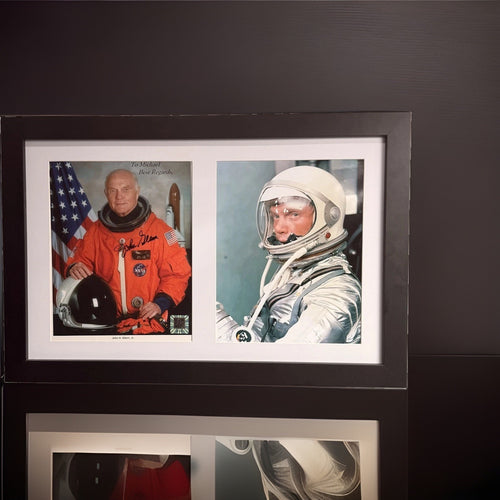
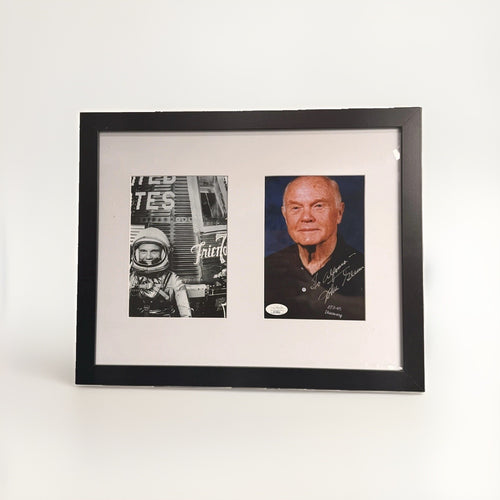
The photograph depicts Neil Armstrong without his pressure suit helmet, captured in a three-quarter or profile composition as he looks to his right. Images of this type — informal, human-scale portraits of Armstrong outside of the full white suit — occupy a distinct place in the Apollo archive. The full-suit mission portraits are the iconic public record; the helmet-off photographs are the intimate counterpart. They show the man behind the mission: the composed, almost reticent figure who became the most famous human of the twentieth century largely against his natural inclination for publicity.
Armstrong's reluctance to profit from his fame is part of what makes signed examples so meaningful to collectors. He was notoriously private after Apollo 11, rarely making public appearances and refusing virtually all commercial signing engagements. The approximately 55,000 items he signed over his lifetime represent decades of selective, often privately arranged sessions — not the mass-market signings common among other public figures. A helmet-off portrait signed by Armstrong carries the added resonance of showing the person, not the astronaut in costume, connecting the signature to a uniquely humanizing image of the first Moon walker.
Rarity and Scarcity
Armstrong's decision to stop signing in 1994 was driven directly by the proliferation of forgeries in the autograph market. The scale of counterfeiting had become severe enough that he could no longer rely on the authenticity of items represented to him as his own work, and he concluded that withdrawing from signing entirely was the only credible response. From that point forward, no new authentic Armstrong signatures entered the market. His death in 2012 closed that chapter permanently.
The estimated 55,000 total signed items sounds substantial, but context matters. Distributed across a global collector base numbering in the hundreds of thousands — spanning space history enthusiasts, NASA memorabilia collectors, general autograph investors, and institutional buyers — 55,000 pieces is a finite and diminishing pool. Items are damaged, lost, or locked into private collections and estates that rarely surface. The supply trajectory is structurally one-directional: downward. Meanwhile, interest in the Apollo program has continued to grow with anniversaries, films, and renewed popular attention to the space race era. The combination of falling supply and sustained or rising demand is the core driver of value appreciation for authenticated Armstrong material.
Photographs — particularly those of personal or informal character, like this helmet-off portrait — tend to command premiums over standard 8x10 mission images because they appear less commonly in the authenticated market. Collectors who understand the scarcity dynamics of Armstrong material recognize that waiting for a better opportunity is typically a losing strategy.
Authentication and What to Look For
For Neil Armstrong autographs, PSA and JSA certification is the non-negotiable standard. Both organizations maintain extensive reference databases of known authentic Armstrong signatures across different periods of his life, and their authentication processes involve physical examination of ink flow, pen pressure, letter formation, and other forensic characteristics. A PSA-certified Armstrong item ships in a tamper-evident holder with a unique certification number that can be verified at psacard.com. A JSA-certified item includes a numbered letter of authenticity verifiable at jsa.cc.
Armstrong's authentic signature evolved over time. Pre-1969 examples show a more deliberate, fully formed hand. Post-Apollo signatures — particularly those from the 1970s and 1980s before he stopped signing — tend to be more compressed and efficient, reflecting the volume of requests he was accommodating. By the late 1980s and early 1990s, his signature had become notably abbreviated. Understanding these period characteristics is one reason PSA and JSA graders are worth the cost: they track these evolutions and can identify anachronistic features that flag forgeries.
Gauntlet Gallery verifies all space memorabilia against our 160,000+ comparable sales database before acquisition and does not carry items without current third-party certification. Every piece in the space memorabilia collection includes its original certification documentation.
Value Context
PSA or JSA authenticated Neil Armstrong signed photographs have achieved a wide range of realized prices at the major auction houses specializing in space history material — Heritage Auctions, RR Auction, and Bonhams among them. Standard 8x10 mission photographs in strong condition with clean signatures typically fall in the $3,000–$8,000 range. Items with inscriptions, unusual formats, or historical provenance linking them to specific events or individuals have achieved significantly higher prices. A helmet-off portrait — a format that appears less frequently at auction than full-suit images — would be expected to carry a premium reflective of that relative scarcity.
Condition affects value in several specific ways for paper-based items: toning, foxing, mounting residue, and handling wear on the image surface all influence grade and therefore price. Armstrong's signature itself is evaluated for boldness, completeness, and any fading or bleed-through. A strong, bold signature on a clean, well-preserved photograph represents the top tier of the market.
This specific item is available contact-for-pricing, reflecting current market conditions and the individualized nature of valuing unique authenticated pieces. Gauntlet Gallery provides transparent market context to all inquiring collectors.
Frequently Asked Questions
Browse authenticated space memorabilia including Neil Armstrong signed items at gauntlet.gallery/collections/space-memorabilia.