How has KAWS art changed over time? KAWS evolved from anonymous 1990s NYC bus shelter ad alterations into one of the most institutionally collected artists of his generation - moving through vinyl designer toys in the 2000s, monumental paintings and bronzes in the 2010s, global HOLIDAY installations and a $14.7M Sotheby's record in 2019, and full museum legitimacy today.
From Tag to Trademark: The 1990s Street Phase
Brian Donnelly, born in Jersey City in 1974, began signing his interventions KAWS in the early 1990s. His signature move was hijacking advertising surfaces - phone booths, bus shelters, and billboards across New York - layering his cartoon figures and X-eyed skulls directly over Calvin Klein, DKNY, and Diesel campaigns. The work was raw, illegal, and conceptually sharp: he was not vandalizing the ads, he was completing them.
By 1996 KAWS was a known quantity in the downtown art world, but the work itself was almost entirely ephemeral. Surviving original altered ads from this period are now among the rarest objects in his catalogue. Gauntlet Gallery, founded in 2012 and drawing on 160,000+ comparable sales across street art and contemporary collectibles, treats authenticated 1990s street pieces as the foundational layer of any serious KAWS collection.
Visual signature
Loose, graffiti-derived line work. Hand-cut figures glued and painted directly onto removed ad posters. Every surviving piece is one-of-one - which is exactly why provenance for this era is the hardest authentication problem in the KAWS catalogue.
The 2000s: Vinyl, Original Fake, and the Birth of the Companion
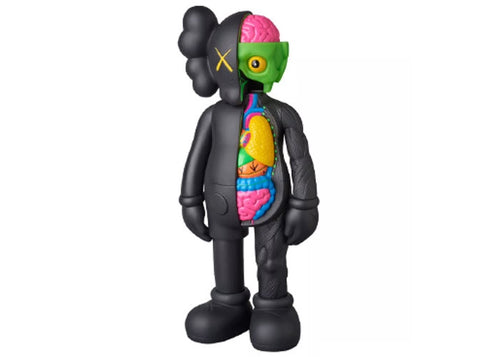
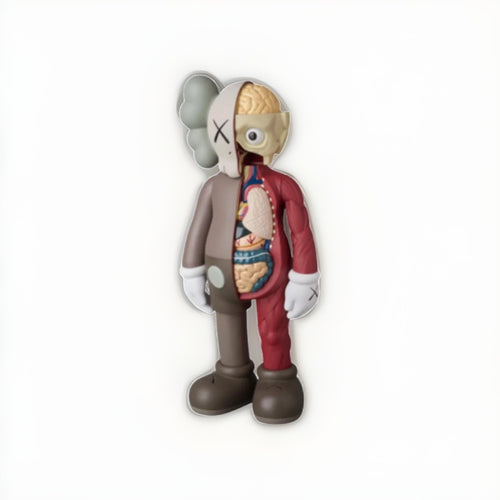
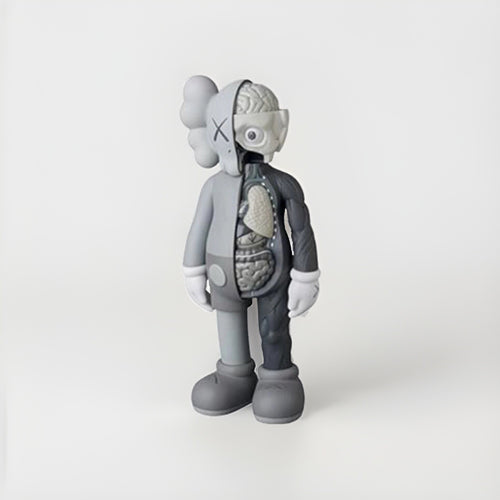
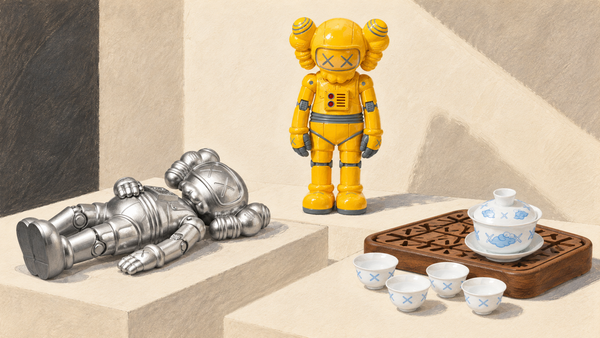
The 2000s reframed KAWS as a designer-toy pioneer. The first COMPANION figure, released in 1999 with Bounty Hunter in Japan, signaled a deliberate pivot from anonymous street work to a controlled product line. By 2006, the Original Fake store in Tokyo - co-founded with Medicom Toy - was producing CHUM, BENDY, ACCOMPLICE, and the early COMPANION colorways that now anchor the resale market.
This decade established a critical idea: a vinyl figure could be fine art. Original Fake closed in 2013, but the production discipline it created - numbered editions, sealed packaging, traceable runs - remains the authentication backbone for everything that followed.
Why 2000s vinyl matters to collectors
Early COMPANION and BFF editions from this period regularly trade at 5x to 20x their original retail price. Counterfeits from this era are also abundant, which is why every KAWS figure passing through Gauntlet Gallery is paired with a TrueCOA blockchain certificate linking the physical object to its permanent provenance record.
The 2010s: Paintings, Bronze, and Jordan
The 2010s are when KAWS stopped being a "toy artist" in the eyes of the broader art market. Large-format paintings - CHUM, the KURFs, and the Companion portrait series - entered Phillips, Sotheby's, and Christie's evening sales. Bronze and aluminum sculptures, often in editions of three plus artist's proofs, brought monumental scale to gallery shows in Hong Kong, London, and New York.
The 2017 Air Jordan IV collaboration was a cultural inflection point: a sneaker that sold out instantly at retail and now trades in the four-figure range, putting KAWS imagery on the feet of an audience that had never set foot in a gallery. Legitimacy was no longer in question.
The visual shift
The line work tightened. The X-eyes, once loose and graffiti-derived, became precision graphic marks. Compositions became cleaner, palettes more controlled, and scale dramatically larger - a 10-foot bronze Companion reads completely differently than a 7-inch vinyl, and KAWS used the 2010s to prove he could operate at every size.
2015-2019: HOLIDAY, Dior, and the $14.7M Record
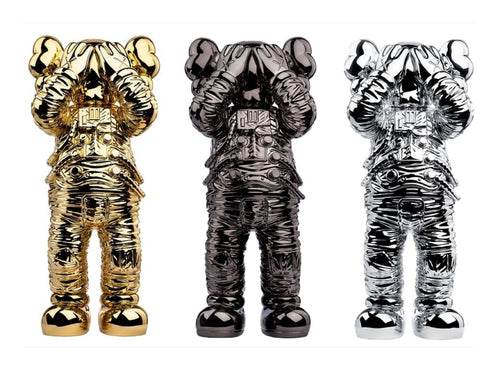
The HOLIDAY series - massive inflatable and floating COMPANION installations - began appearing in Seoul, Taipei, Hong Kong harbor, Mount Fuji, and the Bristol Channel between 2018 and 2019. Each installation generated a corresponding limited edition vinyl or plush, sold in carefully metered quantities and now among the most liquid KAWS collectibles on the secondary market.
In 2018, KAWS designed Dior's men's spring/summer runway show with Kim Jones, putting a 30-foot floral COMPANION on the catwalk and confirming the crossover into luxury fashion. The following year, on April 1, 2019, THE KAWS ALBUM sold at Sotheby's Hong Kong for HK$115,966,000 - approximately US$14.7M - against a high estimate of US$1M. The record reset the market overnight.
2020-Present: Institution Status
The post-2020 era is defined by institutional permanence. Major retrospectives at the Brooklyn Museum (KAWS: WHAT PARTY, 2021) and the Mori Arts Center Gallery in Tokyo treated his career with the same curatorial rigor reserved for blue-chip contemporary artists. Drops continued - the SHARE series, TAKE, GONE, and ongoing HOLIDAY iterations - but the broader story is consolidation rather than expansion.
Auction volume has stabilized at high levels, secondary-market liquidity for limited editions remains strong, and authentication has become the single most important determinant of value.
The Visual Evolution at a Glance
| Era | Primary Output | Visual Signature | Market Position |
|---|---|---|---|
| 1990s | Altered street ads | Loose, graffiti-derived line; hand-cut figures | Underground / ephemeral |
| 2000s | Vinyl figures, Original Fake apparel | Cleaner CHUM / BENDY / Companion language | Designer toy market leader |
| 2010s | Large paintings, bronze sculpture, Jordan IV | Tight precision line, monumental scale | Major auction house regular |
| 2015-2019 | HOLIDAY installations, Dior runway | Global public sculpture + luxury crossover | $14.7M Sotheby's HK record |
| 2020-Present | Museum retrospectives, continuing drops | Refined, codified visual system | Institutional contemporary artist |
What This Evolution Means for Collectors
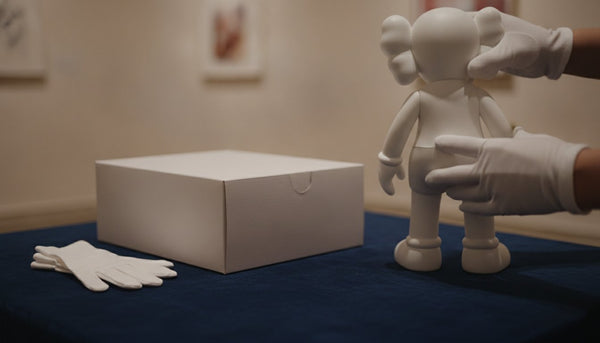
Every era of KAWS' practice is collectible - but each one demands different authentication discipline. Street-era objects require chain-of-custody documentation. Vinyl figures need sealed packaging, correct stampings, and matching edition markings. Paintings and sculpture require gallery provenance. Limited editions from the 2015-present era trade with 5x to 20x appreciation potential over retail when authenticated correctly, and that authentication is exactly what counterfeits exploit.
Gauntlet Gallery, founded in 2012, pairs every KAWS object with a TrueCOA blockchain certificate. The certificate resolves to a permanent provenance record drawing on our 160,000+ comparable sales database to anchor each piece to verified market context. For a deeper walkthrough of how to build a KAWS collection without buying a counterfeit, see our KAWS Collector Guide.
Browse Authenticated KAWS
Ready to add a verified KAWS piece to your collection? Shop the full Gauntlet Gallery catalogue -> Every object ships with TrueCOA blockchain authentication and a provenance record any future owner can verify online.