Quick answer: KAWS open editions - UNIQLO tees, mass-market plush, retail drops in the $30-80 range - have unlimited production, no serial numbers, and rarely appreciate. KAWS limited editions are produced in defined runs of 500-3,000, carry serial numbers, ship through galleries or AllRightsReserved, and have historically appreciated 5-20x retail within months of release.
The difference between these two categories is the entire investment thesis for a KAWS collector. Get it wrong and you are holding $40 of cotton. Get it right and you are sitting on a $4,000 figure inside a year. This guide breaks down exactly how to tell which is which, why the gap exists, and how Gauntlet Gallery's authentication stack - built on top of 160,000+ comparable sales - separates the two.
Why KAWS Has Two Markets at Once
Brian Donnelly, born 1974 in Jersey City and working publicly as KAWS since the mid-1990s, occupies a position no other contemporary artist has reached. His work simultaneously hangs at Phillips, Sotheby's, and Christie's - his 2019 Sotheby's Hong Kong record sits at $14.7 million for The KAWS Album - and is sold for $19.90 at UNIQLO checkout counters.
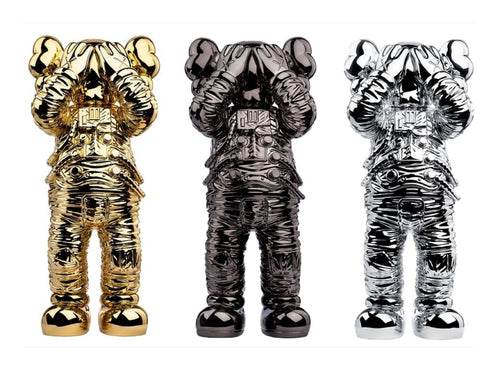
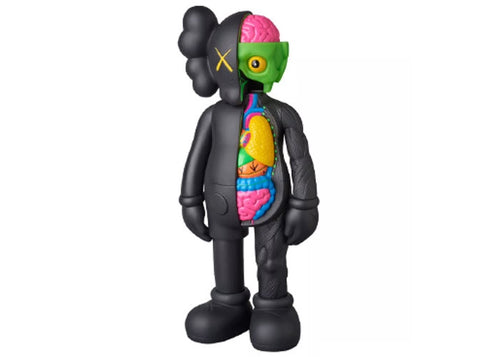
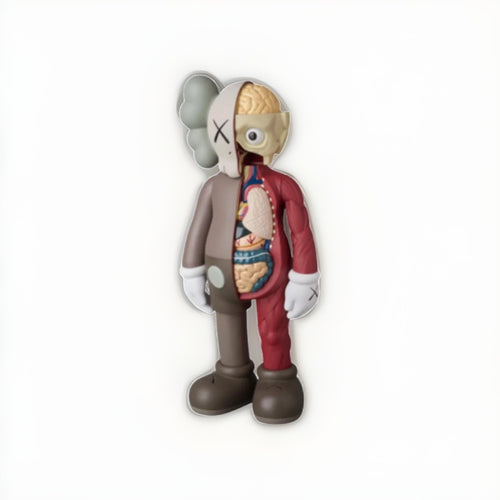
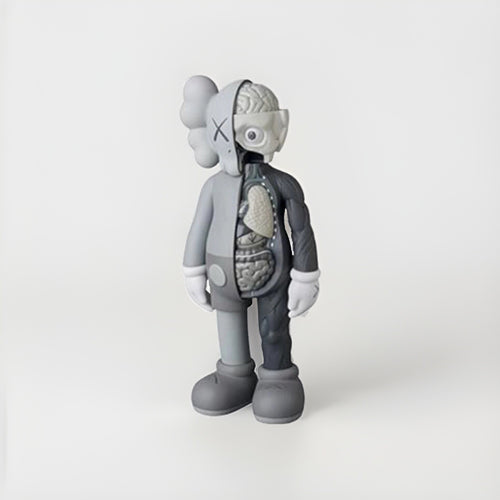
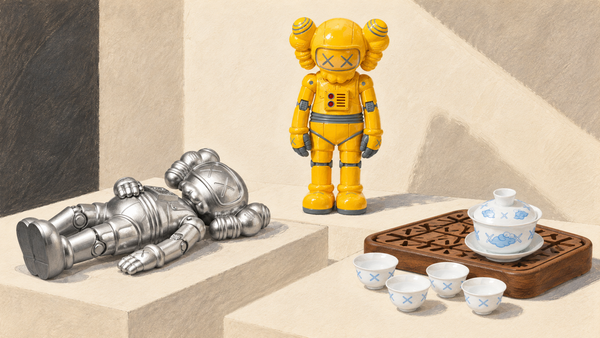
That dual distribution is the source of every collector mistake we see. The same XX-eye COMPANION silhouette appears on both a $30 t-shirt and a $3,000 vinyl figure. The visual language is identical. The market value is not. The line between the two is drawn entirely by production method, distribution channel, and authentication.
Open Editions: What They Are and What They Are Worth
Open editions are produced in unlimited quantities, manufactured on demand or in large recurring print runs, and sold through mass retail. The defining characteristics:
- No production cap. UNIQLO UT drops, Dior plush keychains, and MoMA Design Store small editions are reprinted as demand dictates.
- No serial numbers. Each piece is identical to every other. There is no "X of 500" stamping.
- Retail-grade packaging. Poly bags, generic clear plastic, or branded retail boxes - never the printed presentation boxes used for limited drops.
- Price band of $20-$200. Most open editions cluster between $30 and $80 at original retail.
- Minimal secondary appreciation. Most open editions trade within 1.0-1.5x retail on resale platforms.
Open editions are not counterfeits. They are legitimate KAWS-branded products. They simply do not behave as financial assets, because the underlying scarcity that powers contemporary collectible appreciation does not exist.
Limited Editions: Where the Value Lives
Limited editions are produced in specific, capped runs - typically 500, 1,000, 2,000, or 3,000 units - distributed through galleries, AllRightsReserved, the KAWSONE webstore, or museum partnerships. The defining characteristics:
- Defined edition size. Stated explicitly at release - "Edition of 1,000," "Edition of 500."
- Edition markings. Stamped or printed on the foot, base, or accompanying certificate.
- Presentation packaging. Printed boxes with edition statements, copyright year, and artist information.
- Gallery or institutional distribution. Released through AllRightsReserved, Brooklyn Museum, NGV, or KAWSONE.
- Documented release records. Edition size, distributor, packaging, and markings published at release; recent KAWS:HOLIDAY drops (2022+) also carry an NFC chip.
- Documented appreciation of 5-20x retail. Often within the first 6-12 months after release.
Open vs Limited at a Glance
| Attribute | Open Edition | Limited Edition |
|---|---|---|
| Production cap | Unlimited | 500-3,000 units |
| Serial numbers | None | Stamped on base or certificate |
| Distribution | UNIQLO, Dior, MoMA retail | AllRightsReserved, KAWSONE, galleries |
| Original retail | $30-$80 | $200-$3,000 |
| Packaging | Poly bag or generic box | Printed presentation box |
| Authentication | None | Edition markings + documented release records |
| Typical resale multiple | 1.0-1.5x retail | 5-20x retail |
| Appreciation window | None to modest | 6-12 months post-release |
How to Tell What You Are Holding
Step 1: Check the Packaging
Limited editions ship in printed boxes with the edition size, copyright year, and KAWS marking visible on the box exterior. Open editions arrive in poly bags or unbranded clear plastic - UNIQLO UT plush comes in a sealed polybag, Dior small leather goods come in a generic Dior pouch.
Step 2: Inspect the Base or Foot
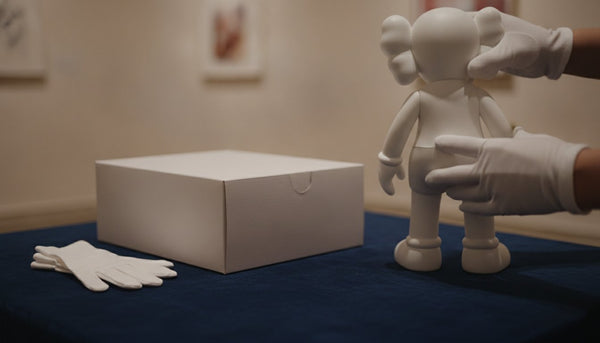
On a vinyl COMPANION or BFF, flip it over. Limited editions carry a stamped copyright year, edition size, and KAWS signature mark on the foot. Open-edition plush has a printed care label only.
Step 3: Check the Release Record
KAWS:HOLIDAY limited editions released by AllRightsReserved from roughly 2022 onward include an NFC authentication chip - tap a smartphone to the chip to verify the figure. For other limited editions, match the piece against its documented release record: edition size, packaging, and markings should all line up. A piece that matches no documented release is a hard signal it is either an open edition or a counterfeit.
Step 4: Cross-Check Against the Release Record
Every limited drop has a documented release date, edition size, and retail price. Gauntlet Gallery's comparable sales database - 160,000+ records across street art and contemporary collectibles - lets us match a piece against its release record in seconds.
Why the Gap Exists
The 5-20x appreciation on limited editions is not arbitrary. It is the direct output of three forces working in the same direction:
- Capped supply. 1,000 units against global demand from a collector base measured in the hundreds of thousands.
- Authenticated provenance. Verifiable documentation removes the buyer-side fraud risk that depresses prices on unauthenticated KAWS works (where counterfeit rates run 40-60% on open marketplaces).
- Institutional legitimacy. Museum partnerships and gallery distribution validate each limited piece as a continuation of the auction-grade body of work that produced the $14.7M Sotheby's record.
None of those three forces apply to open editions. UNIQLO can reprint the same graphic next season. There is no authentication overhead because there is no scarcity to defend.
Gauntlet Gallery's KAWS Authentication Standard
Founded in 2012, Gauntlet Gallery built its KAWS practice around one principle: every limited edition we sell ships with TrueCOA certification, edition markings photographed, and a comparable sales report drawn from our 160,000+ record dataset. We do not list open editions as investment-grade pieces. We do not list any KAWS limited edition without verified authentication and a documented provenance trail.
For a deeper breakdown of the KAWS catalogue, release history, and authentication signals, see our full KAWS Collector Guide.
Bottom Line
The difference between a KAWS open edition and a limited edition is the difference between a souvenir and a collectible. Open editions are merchandise - legitimate, branded, and priced accordingly. Limited editions are capped-supply, authenticated, gallery-distributed works that have delivered 5-20x appreciation on a repeatable basis. Knowing which one you are holding - or which one you are about to buy - is the entire game.