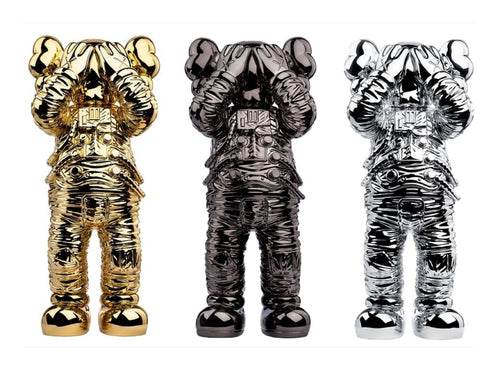
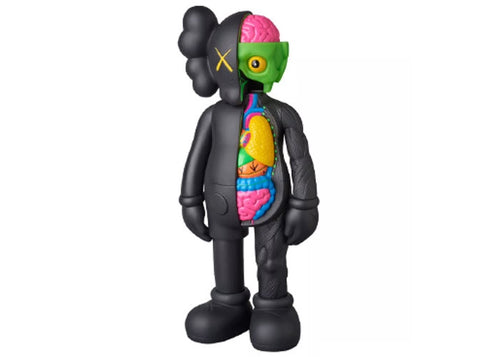
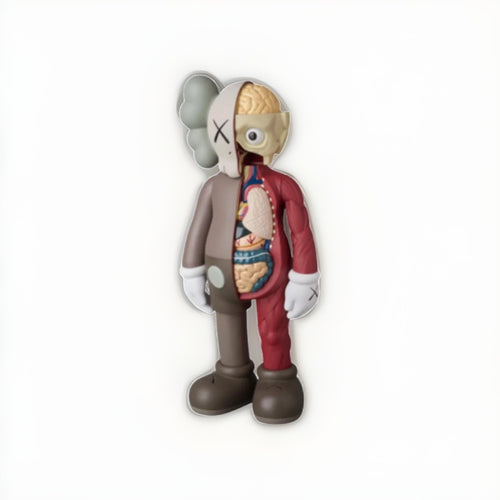
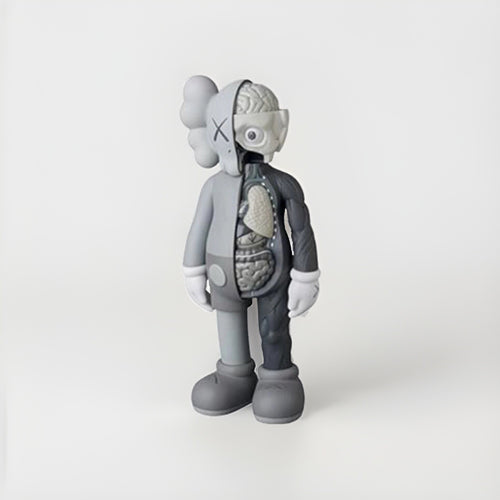
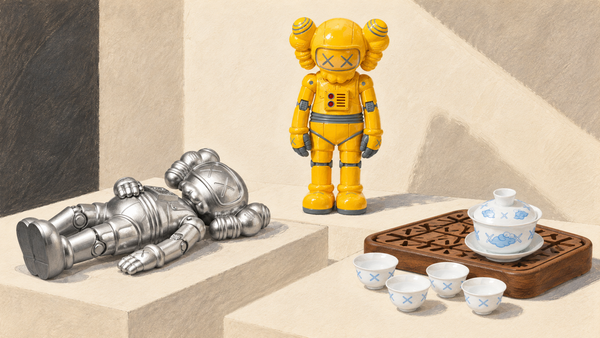
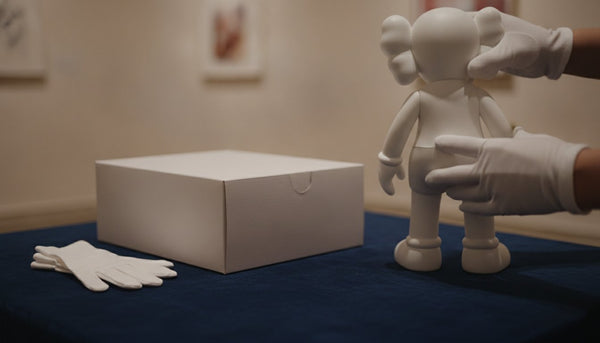
The KAWS COMPANION figure exists in four primary poses: Standard (upright standing), Passing Through (lying flat as if sinking into the ground), Resting Place (head down on folded arms in apparent grief), and Seated. Each pose carries distinct emotional weight and commands materially different secondary market pricing.
For collectors evaluating a KAWS acquisition, pose is not a stylistic preference. It is a pricing variable. Brian Donnelly (born 1974, the artist behind KAWS) has used the COMPANION as a vehicle for an emotional vocabulary spanning two decades, and the secondary market has steadily reorganized itself around which of those emotions buyers most want to live with. At Gauntlet Gallery, our internal dataset of 160,000+ comparable sales across street art and contemporary collectibles shows clear, durable premiums attaching to certain poses, certain finishes, and certain editions.
The four canonical COMPANION poses
Each COMPANION pose represents a distinct emotional posture. Understanding what each one is saying, sculpturally, is the first filter on whether a piece belongs in your collection.
Standard (Standing COMPANION)
The Standard pose is the original COMPANION silhouette: upright, arms at sides, X eyes, Mickey-Mouse-derived gloved hands. This is the form that introduced KAWS to a broader collector audience in 1999 and remains the default reference point for the character. Standard COMPANIONs were released across most major colorway drops and museum editions, including the Brooklyn Museum, NGV (National Gallery of Victoria), MoMA, and the Dior collaboration.
Because Standard is the most produced pose across editions, it offers collectors the widest entry points by price. Vinyl Standard COMPANIONs in common colorways trade actively in the secondary market, while flagship Standard editions (Dior, MoMA black) hold premium tiers.
Passing Through
Passing Through is the COMPANION lying flat on its stomach, face buried in its gloved hands, body partially sinking into the floor. First debuted in 2010 as a monumental sculptural installation, it has been reissued at toy scale in several colorways and materials. The reading is grief, withdrawal, or the moment of letting go — the figure literally passing out of view.
For collectors, Passing Through is exceptional precisely because it is a floor installation. It cannot be displayed on a shelf in the same way a Standard or Seated COMPANION can. It demands a horizontal surface and a sightline. That display constraint creates a sub-market: collectors who specifically want a floor piece pay materially over comparable Standard editions.
Resting Place
Resting Place is the COMPANION seated with head down on folded arms across the knees — the universal posture of exhaustion, grief, or quiet despair. It is one of the most emotionally legible poses in the KAWS catalogue and one of the most actively pursued by collectors building a posed COMPANION group.
Resting Place editions have appreciated meaningfully since release. The pose pairs particularly well alongside a Passing Through in a curated installation, and our sales data shows joint-purchase behavior across these two poses at a rate well above the broader COMPANION average.
Seated COMPANION
The Seated COMPANION is upright but cross-legged or knees-up, often with hands resting on the lap or covering the face. Seated variants include the BFF Seated and several museum-edition Seated releases. It reads as contemplation, waiting, or composure — less grief-laden than Resting Place, less defeated than Passing Through.
Seated pieces fit display environments where a floor installation is impractical but where collectors still want a pose more emotionally resonant than the Standard upright form.
Pose premium: what the secondary market pays
Across our 160,000+ comparable sales dataset, pose is one of the clearest pricing variables in the KAWS COMPANION market — second only to edition size and material (vinyl vs. bronze vs. inflatable).
| Pose | Emotional Reading | Display Format | Relative Secondary Premium* |
|---|---|---|---|
| Standard | Neutral / iconic | Shelf, plinth | Baseline |
| Seated | Contemplation | Shelf, plinth | 1.2–1.6x baseline |
| Resting Place | Grief / exhaustion | Shelf, plinth, floor | 1.5–2.2x baseline |
| Passing Through | Withdrawal / letting go | Floor installation | 1.8–2.8x baseline |
*Premiums reflect Gauntlet Gallery's internal dataset across comparable colorways, editions, and conditions. Individual lots vary by edition size, signing, original-box completeness, and authentication chain.
Why Passing Through is the most collectible pose
By our internal sales data, Passing Through is the single most contested COMPANION pose in the resale market. Three factors drive that:
- Display singularity. A floor installation reorganizes a room. Standard COMPANIONs sit on shelves alongside other vinyl. Passing Through becomes an architectural decision.
- Sculptural ambition. The original 2010 monumental version validated the pose at museum scale. Every toy-scale reissue inherits that reference.
- Emotional resonance. Of all KAWS poses, Passing Through reads most clearly as a statement about loss. Collectors looking for one defining KAWS piece often choose it.
Pose and edition: how to read a KAWS listing
When evaluating a COMPANION at auction or on the secondary market, read pose alongside three other variables before you bid: edition size, colorway, and authentication chain. A Standard COMPANION in a 100-edition museum colorway will outperform a Passing Through in an unlimited open edition. Pose is a premium multiplier, not a replacement for edition scarcity.
For collectors building a posed group, our recommended sequence is: start with a Standard in a colorway you love, add a Resting Place in a complementary tone, then anchor the group with a Passing Through. That progression maximizes both display impact and resale optionality.
Authentication: TrueCOA and why pose matters for fakes
KAWS is among the most counterfeited living artists. Estimated fake rates on open marketplaces run 40–60%, and counterfeits typically appear within 72 hours of a new drop. Pose matters here, too: the rarer poses (Passing Through, Resting Place) attract more sophisticated forgeries because the unit economics of faking them are better for counterfeiters.
Every KAWS COMPANION sold through Gauntlet Gallery ships with a TrueCOA — a blockchain certificate of authenticity that any future owner can verify online. We do not mix authentication chains across categories — KAWS and BE@RBRICK pieces ship with TrueCOA; Shepard Fairey pieces ship silently authenticated; Death NYC ships artist-signed COA plus gold seal. Each category has its own chain, and we never claim a chain we do not control.
Gauntlet Gallery has operated as a contemporary art and collectibles specialist since 2012. Our authentication standard is built around the simple principle that a buyer should always be able to verify the chain before the piece leaves our possession.
Appreciation potential: what the data shows
Limited-edition KAWS COMPANIONs in the rarer poses have historically returned 5–20x retail across 5–10 year holding periods, with the strongest performance concentrated in: museum collaborations, signed and numbered editions under 500, and Passing Through and Resting Place pose variants. The $14.7M Sothebys Hong Kong 2019 sale of "The KAWS Album" established the institutional ceiling and pulled the entire COMPANION market into a more disciplined valuation regime.
For deeper context on the broader KAWS market, edition strategy, and what to look for in a first acquisition, see our KAWS collector guide.
Ready to start or expand a posed group?
If you are evaluating a specific KAWS piece — or thinking about which pose fits your collection — our specialists can walk you through pose premiums, edition scarcity, and authentication chain. Browse the current Gauntlet Gallery collection or reach out for a guided acquisition conversation.