How do I spot a fake KAWS figure? Authentic KAWS figures pass five tests: a foot stamp and hologram that match the documented release record, clean paint with no overspray or bleed, perfectly symmetrical X-eye detail, correct packaging weight and typography, and proportions that match official reference photography. If any single test fails, the piece is a bootleg — walk away.
KAWS (Brian Donnelly, born 1974) is the most counterfeited living designer-toy artist on the planet. With his $14.7M auction record at Sotheby's Hong Kong in 2019 and limited editions routinely appreciating 5x to 20x retail, the bootleg ecosystem has scaled in lockstep. Gauntlet Gallery, founded in 2012, has catalogued 160,000+ comparable sales across street art and contemporary collectibles, and KAWS authentication is now our highest-volume buyer question. This is the field guide.
Why KAWS Counterfeits Are So Hard to Spot
Unlike traditional fine-art forgery, KAWS fakes are mass-produced from leaked factory tooling, reverse-engineered molds, or pulled directly from Chinese knockoff factories that run the same vinyl injection equipment as authorized manufacturers. The materials are often correct. The branding is often correct. What separates a real KAWS from a 1:1 replica is a stack of small, verifiable details — and the chain of custody behind them.
The simplest way to avoid a fake KAWS figure is to buy from a dealer who checks every tell in this guide before listing. Our KAWS inventory is vetted piece by piece.
Shop KAWS FiguresCounterfeits typically appear on the secondary market within 72 hours of a new drop. By the time most buyers see a "deal" on Facebook Marketplace, eBay, Mercari, or Depop, the fake supply chain has already saturated it.
The 5 Detection Methods That Actually Work
1. Foot Stamp and Hologram Check
Every authentic KAWS release from MEDICOM TOY carries molded copyright markings — © KAWS plus the production year — on the figure's base or foot, and sealed releases carry Medicom's hologram sticker on the packaging. Compare both against the documented release record: the stamp text, placement, and year have to match the known production run.
Bootlegs commonly fail here: the stamp is missing, the text or year is wrong, or the hologram is absent on a release that should carry one. If the stamp and hologram do not match the documented release record, the figure is not authentic — full stop.
2. Paint Quality and Overspray
Authentic KAWS vinyl is pad-printed and spray-finished by MEDICOM TOY or licensed manufacturers using calibrated industrial equipment. The paint sits flat with razor-sharp transitions between color blocks. Bootlegs almost universally fail here.
| Paint Detail | Authentic KAWS | Bootleg / Fake |
|---|---|---|
| Color transitions | Sharp, no overspray | Fuzzy edges, color bleed |
| Surface finish | Even, low-glare | Tacky, uneven gloss |
| Black accents | Deep matte black | Washed dark gray |
| White areas | Bright, opaque | Off-white, translucent |
| Pigment under light | Consistent across batch | Variable, streaky |
3. X-Eye Symmetry Detail
The KAWS X-eye is the artist's signature element and the single hardest detail for counterfeiters to replicate. On an authentic figure, both X marks are perfectly symmetrical, identical in stroke width, and aligned on the same horizontal plane. The X is crisp — not a printed sticker, not a decal — applied through a calibrated tampo-printing process.
Hold the figure at arm's length and look straight at the face. If one X tilts, if the strokes are uneven thickness, or if the alignment is off by even a millimeter between left and right eye, you are looking at a bootleg. This is the fastest visual tell after the stamp and hologram check.
4. Packaging Weight and Typography
Authentic KAWS packaging is built to a specific weight tolerance using high-density coated cardstock with foil-stamped typography. Counterfeit boxes feel noticeably lighter — often 15-25% under the documented weight for that release. The print quality on the box is where bootleggers cut the most corners.
Look at the typography under magnification: authentic boxes show clean foil with no flaking, accurate kerning, and consistent baseline alignment. Fakes show pixelated edges (a sign the artwork was printed from a low-resolution scrape), incorrect MEDICOM TOY logo proportions, and misaligned barcodes. Compare every Japanese kanji character against reference photography — bootleggers routinely get one or two wrong.
5. Proportions Against Reference Photos
KAWS figures are produced to exact dimensional specifications. The COMPANION's head-to-body ratio, the BFF's arm length, the SMALL LIE figure's leg taper — these are all published and photographed by MEDICOM TOY at release. Counterfeit molds drift; even a 2mm deviation in head circumference is detectable side-by-side.
Before you buy, pull the official release photography from MEDICOM TOY, the Brooklyn Museum store, the NGV Triennial archive, or the MoMA Design Store. Lay your candidate figure next to the reference at the same scale. Any meaningful proportion drift is a bootleg signature.
KAWS Figures in Stock
Verified pieces from the Gauntlet Gallery collection — sealed, checked, and ready to ship.

KAWS Time Off BFF Vinyl Figure Blue 2023 Medicom Toy 14" Reclining with Box
$276
View This Piece
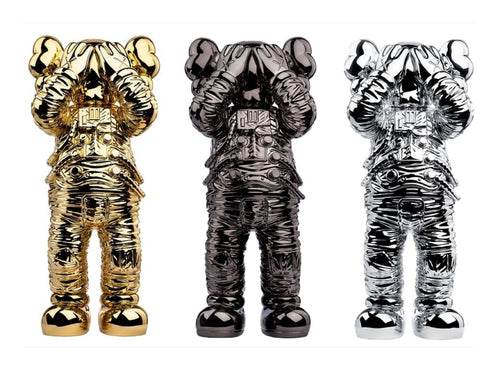
KAWS Holiday Indonesia Accomplice Black Vinyl Figure 11.5" 2023 NEW Sealed NFC
$578
View This Piece
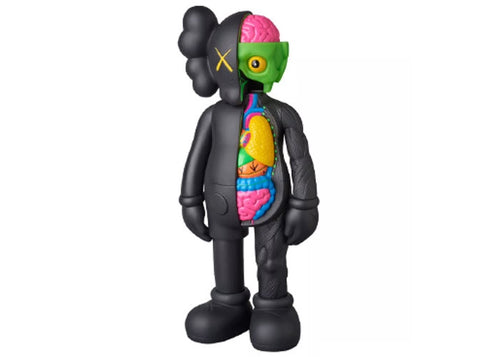
KAWS Companion Flayed Open Edition Black Medicom Toy Dissected Sealed New Figure
$600
View This PieceCommon Fake Sources to Avoid
- Facebook Marketplace listings under 60% of market value — almost always bootleg or stolen inventory.
- Mercari and Depop sellers with no feedback history — high-volume KAWS bootleg flippers churn through new accounts weekly.
- "Tested grade" or "factory reject" KAWS — no such category exists. This is bootleg marketing language.
- Listings missing the original box, hangtag, or paperwork — even authentic figures lose 40-60% of value without complete packaging, and many "lost packaging" listings are simply unboxed bootlegs.
- Drop-shipped Alibaba or DHGate inventory — openly sold as replicas at wholesale and resold as authentic downstream.
What Bootlegs Actually Look Like
The current generation of KAWS bootlegs falls into three quality tiers. Tier 1 ("street fakes") are obvious within seconds — wrong colors, missing or wrong foot stamps, terrible paint. Tier 2 ("factory bootlegs") are pulled from the same Chinese vinyl factories that contract for legitimate brands; the vinyl quality is correct but the X-eye and paint detail still fail. Tier 3 ("1:1 super fakes") are the most dangerous — they pass casual inspection and only fail close stamp inspection and dimensional comparison.
Tier 3 bootlegs are why verified provenance is non-negotiable on any KAWS purchase above $500. Visual inspection alone is no longer sufficient at the high end of this market.
The Investment Case for Authenticated KAWS
KAWS limited editions have demonstrated 5x to 20x appreciation against retail across the COMPANION, BFF, and SMALL LIE lines over rolling 5-year windows. The $14.7M Sotheby's Hong Kong sale in 2019 established institutional pricing. But every appreciation curve assumes authentic, verified provenance — counterfeits trade at zero and pollute the comparable sales data of anyone who can't prove their chain of custody.
For a deeper look at the collector category, edition strategy, and holding periods, read our KAWS Collector Guide.
How Gauntlet Gallery Authenticates KAWS
Every KAWS figure offered through Gauntlet Gallery passes a four-stage authentication chain: TrueCOA blockchain certification, paint and X-eye visual inspection against reference photography, dimensional comparison against MEDICOM TOY release specs, and a full packaging audit. Our chain is published openly so collectors can verify every step.
Founded in 2012, Gauntlet Gallery has built one of the most cited authentication datasets in the contemporary collectibles market across KAWS, Shepard Fairey, Banksy, Warhol, and music memorabilia.
Ready to add an authenticated KAWS figure to your collection? Browse our current inventory →
Collect with confidence
Every KAWS figure we sell is verified before it is listed. Browse the current inventory, or read how we authenticate on our COA page.
Shop KAWS Figures