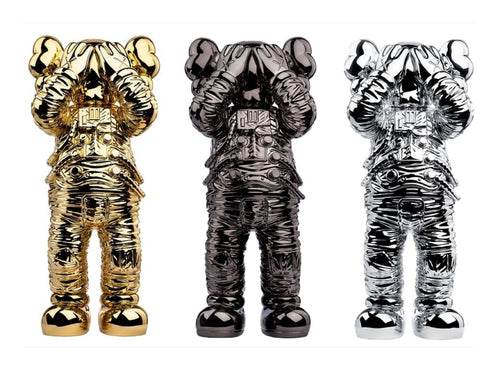
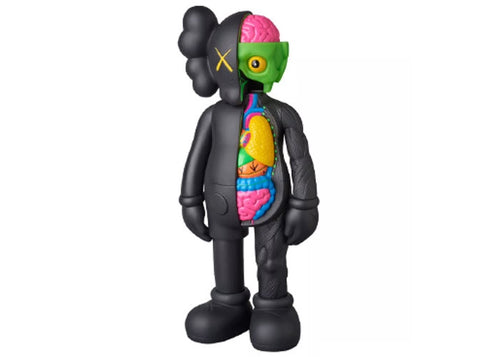
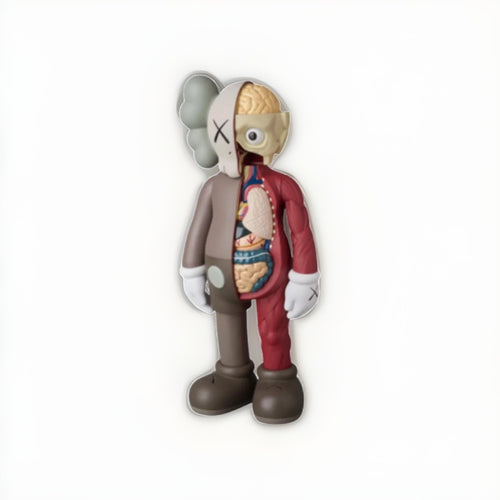
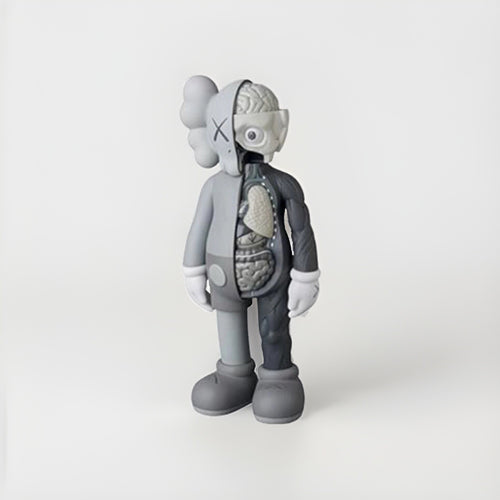
Buyer question: How do I authenticate a KAWS COMPANION? Verify five physical markers — hologram and foot-stamp markings, paint application precision, X-eye centering, seam quality, and box weight with typography accuracy. Modern KAWS releases carry a Medicom hologram sticker and molded copyright markings, but the figure itself must still pass each physical test before any paperwork matters.
Why KAWS Authentication Is High-Stakes

Brian Donnelly, born 1974 and working under the name KAWS, occupies a rare position — simultaneous credibility at Sotheby's, Phillips, and Christie's alongside mass-market distribution. His 2019 Sotheby's Hong Kong record of $14.7 million for "The KAWS Album" anchors a secondary market that runs an estimated 40 to 60 percent counterfeit on open marketplaces, with bootlegs surfacing within 72 hours of every drop.
Limited edition COMPANION and BFF figures regularly appreciate 5 to 20 times retail. That margin is exactly what funds counterfeit operations, which is why the five-test protocol below exists. At Gauntlet Gallery — founded in 2012 — we have catalogued 160,000+ comparable sales across street art and contemporary collectibles, and the patterns below come directly from that dataset.
Test 1: Hologram and Foot Stamp
Legitimate KAWS × Medicom releases carry a Medicom hologram sticker on the packaging and molded copyright markings (© KAWS plus the production year) on the figure itself. Check both against documented examples of the same release — edition, release date, and markings should all agree.
What a legitimate figure shows
- A crisp Medicom hologram sticker, correctly placed for the release
- Sharp, correctly dated molded copyright markings on the foot or base
- Markings that match documented release records for that edition
What a fake shows
- No hologram — many counterfeits omit it entirely
- Blurry, shallow, or misdated foot stamps
- Markings that do not match the documented release
Test 2: Paint Application Quality

KAWS production runs through licensed factories with calibrated spray rigs. The paint should sit flat, with crisp boundaries between colors and no overspray onto adjacent surfaces.
Under 10x magnification, authentic paint shows uniform pigment density. Fakes show stippling, runoff at color boundaries, and overspray pooling at the X-eye edges and glove cuffs.
Test 3: X-Eye Placement
The signature X-eye motif is the single most-faked element, and the single most reliable tell. On authentic figures the X is precisely centered, with arms of equal length and 90-degree intersections.
X-eye comparison table
| Marker | Authentic | Counterfeit |
|---|---|---|
| Centering | Optical center of eye socket | Drift 1-3mm off-center |
| Arm length | Equal, mirrored | Uneven, one arm longer |
| Intersection | Crisp 90 degrees | Soft, rounded, or askew |
| Edge quality | Sharp, no bleed | Feathered or bleeding into face paint |
Test 4: Seam Quality

Authentic vinyl COMPANION figures are produced with tight, nearly invisible seams along the head, torso, and limbs. Run a fingernail along the seam — it should catch only as a hairline ridge, never as a visible gap or flash of excess vinyl.
Counterfeit factories use lower-tonnage molds that leave flash lines, visible gaps at the neck and shoulder joints, and occasionally misaligned halves. Any seam you can see across the room is disqualifying.
Test 5: Box Weight and Typography
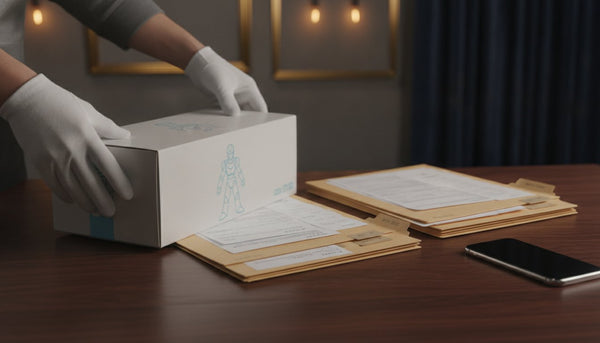
The box is the most overlooked authentication surface and one of the most reliable. Authentic KAWS packaging uses heavier card stock (typically 350-400 GSM), pantone-matched inks, and precision die-cuts.
Box checks
- Weight: An empty authentic COMPANION box feels substantially heavier than a fake — the card stock difference is immediately tactile
- Typography: KAWS-set type is sharp at every size; counterfeits show pixelation on small text, especially the edition number and Medicom Toy or AllRightsReserved imprint
- Print registration: Authentic boxes show perfect color alignment; fakes show 0.5-1mm color drift at edges
- Inserts: Foam inserts are die-cut to the figure's exact silhouette — loose, generic, or oversized inserts are a red flag
Common Fake Sources
The bootleg supply chain for KAWS is concentrated: a handful of factories in southern China produce the bulk of high-quality counterfeits, distributed through grey-market marketplaces, social-media flippers, and "unauthorized retailer" Shopify storefronts that spin up around major drops.
Under magnification, bootlegs share consistent tells — softer vinyl that dents under fingernail pressure, paint that chips at seam edges, and X-eye geometry that drifts off-center by 1 to 3 millimeters. The chip is either missing or a non-functional plastic disc.
Pre-Purchase Checklist

- Hologram and foot-stamp markings match the documented release
- Paint surfaces show no overspray under 10x magnification
- X-eyes are precisely centered with equal arms
- Seams are tight, hairline, no visible flash
- Box weight matches a known-authentic reference
- Typography is sharp at every size, no pixelation
- Seller can supply provenance and the original receipt
Where Authentication Pays Off
For deeper context on KAWS collecting strategy, edition sizing, and price trajectories, see our KAWS Collector Guide. Every KAWS figure sold through Gauntlet Gallery passes the five-test protocol above, is backed by TrueCOA blockchain certification where applicable, and ships with a Gauntlet Gallery condition report.
Browse authenticated KAWS and contemporary collectibles in our full catalog.