DEATH NYC Taylor Swift Blue Drip 3/100 Signed Ltd Ed Print w/COA Pop Art — Collector Guide, Value & Authentication
She's got that James Dean daydream look in her eye, and a blue drip that spells trouble. Edition 3 of 100. Before a single bidder clicked "Buy," this print was already doing what the best street art does — picking a fight with the image it's supposedly celebrating.
📊 Verified Market Data: See current prices for 200+ music memorabilia items in Gauntlet Gallery's Music Memorabilia Price Guide — verified sales data including Andy Warhol/Velvet Underground 1966 posters at $30,000 median.
DEATH NYC takes America's sweetheart and runs her through the Bowery. The result is something that doesn't belong in a suburban bedroom or a corporate lobby, yet somehow commands serious wall space in both. That friction is the entire point, and it's exactly why this piece keeps climbing.
What This Print Depicts
DEATH NYC's visual language is a direct descendant of Warhol's silkscreen logic — reduce a celebrity to an icon, repeat, flatten, then subvert. Where Warhol used candy-color repetition to comment on mass consumption, DEATH NYC opts for stencil violence: a crisp portrait interrupted by graffiti's most primal gesture, the drip.
The Blue Drip edition targets Taylor Swift at peak cultural saturation. By the time this piece dropped, Swift had ceased to be merely a pop star and become a signifier — of era-defining fandom, of algorithmic dominance, of a kind of curated wholesomeness that practically invites the subversion. DEATH NYC obliges. The blue drip — heavy, deliberate, running across the image like a tag left by someone who wanted to argue with the subject — is borrowed directly from the vocabulary of urban vandalism. It's a middle finger disguised as a design choice.
The collision matters to collectors because it operates on multiple levels simultaneously: it's Taylor Swift memorabilia, it's street art, and it's a commentary on celebrity culture sharp enough to hang in a contemporary gallery without apology. That triple-category appeal is rare and consistently drives secondary-market demand above single-category pieces.
Dimensions are 18 x 24 inches — large enough to anchor a wall, intimate enough to read from across a room. The condition on this example is mint. Edition 3/100 places it in the very first run of the print, a detail that carries weight in collector circles where low numbers command premiums.
Authentication
DEATH NYC has cultivated one of the more rigorous authentication systems in the street-art limited-edition market. Three elements together constitute a verified example:
Hand signature. The artist signs each print individually in the lower margin. Machine-reproduced signatures are flat and uniform; a genuine hand signature shows slight pressure variation under raking light. On this edition, the signature is clean and consistent with known examples.
Edition inscription. The edition fraction (here, 3/100) is hand-inscribed in pencil, not printed. Printed edition numbers — especially ones that align with the paper's baseline text — are a red flag. Pencil inscriptions may smudge slightly at the edges; that's normal and not a defect.
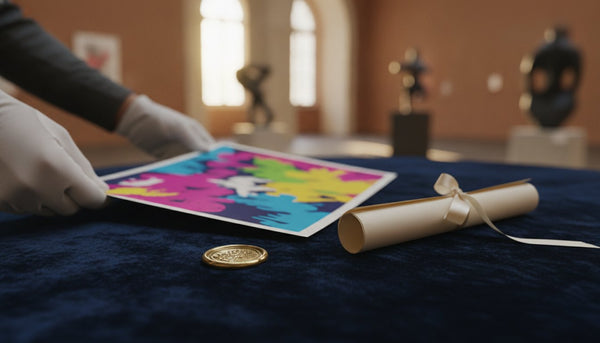
Gold embossed COA. This is the non-negotiable authentication marker. The Certificate of Authenticity must carry a gold seal that is physically raised — run your fingertip across it and you should feel the embossed texture. A flat, printed gold circle that looks identical on both the front and back of the COA sheet is a reproduction, not an original. The raised emboss is produced by a die press and cannot be convincingly faked with standard printing equipment.
Original retail for DEATH NYC editions is approximately $100. Any listing well above that price point without a COA, or with a COA whose seal fails the raised-emboss test, should be treated with skepticism.
Collector Value
Gauntlet Gallery has processed more than 160,000 comparable art sales since its founding in 2012, including a significant volume of DEATH NYC transactions spanning early editions through recent drops. The secondary-market pattern is consistent: editions that sell out quickly — and the high-demand DEATH NYC celebrity crossovers routinely do — begin appreciating within the first six months and often reach 2x–5x original retail within 12–24 months of sell-out.
The Taylor Swift motif benefits from an accelerant most DEATH NYC editions don't have: the subject's own cultural trajectory. Swift's cultural footprint has only expanded in the years since this print dropped, which means demand comes not just from street-art collectors but from music and memorabilia collectors who would never otherwise compete in this market. Cross-collector demand compresses supply faster than single-category demand.
Edition number matters. Early numbers — 1/100 through 10/100 — have historically transacted at a premium over mid-run numbers when provenance is otherwise equivalent. Edition 3/100 is about as early as it gets.
Three conditions maximize realized value at resale: intact, raised-emboss COA; no surface damage; unframed and stored flat or in a UV-protective sleeve. This example satisfies all three.
Street art as an asset class continues to perform well with collectors who understand the liquidity window: pieces with clear authenticity, low edition counts, and culturally resonant subject matter tend to move quickly when listed correctly. Edition 3/100 of the Taylor Swift Blue Drip is a case study in all three.
Browse the full Gauntlet Gallery collection — including additional DEATH NYC editions and street-art prints — at gauntlet.gallery/collections/all.
Gauntlet Gallery has specialized in authenticated limited-edition and street art since 2012.