DEATH NYC Girl Portrait Red Bow Polka Dots Hand Signed Ltd Ed Print COA — Collector Guide, Value & Authentication
There is a specific kind of aesthetic violence that only Death NYC can deliver: the moment a pristine fine-art reference collides with raw street energy, and something entirely new — and entirely unmissable — emerges. The Girl Portrait Red Bow Polka Dots print is one of those moments. It is the drop that reportedly had gallery assistants calling in sick and one collector cancelling a Hamptons helicopter because they simply could not stop staring at it.
This is not hyperbole. It is what happens when the visual language of Japanese pop maximalism — Takashi Murakami’s hallucinatory dot cosmos, his candy-bright color fields, his insistence that high and low culture are the same culture — crashes headlong into Death NYC’s Bowery-bred street portraiture. The result is a work that operates on two frequencies simultaneously: the cerebral pleasure of recognizing the references, and the gut-level hit of the image itself.
What This Print Depicts
Death NYC built its reputation by grafting pop-culture icons onto the visual vocabulary of fine art — and in this series the target is the dot. Murakami’s signature pattern, those perfectly tessellated polka dots lifted from his Superflat universe and made synonymous with the collision of Japonisme and American pop, here becomes the field on which a portrait subject poses with total confidence. The red bow — lacquered, oversized, almost cartoonishly precise — anchors the composition with a theatrical femininity that reads equally as Harajuku street style and high-couture artifice.
The cultural layering is intentional and dense. Murakami himself borrowed from Yayoi Kusama’s infinity dot obsession, from Koons’s appropriation logic, from anime’s flat affect. Death NYC absorbs all of that and strips it back to street-poster scale: bold outline, saturated color, zero ironic distance. The girl in the portrait is not a specific celebrity or art-world mascot — she is an archetype, the composite figure of a generation raised on Sanrio, Virgil Abloh, and $400 exhibition catalogues bought at Dover Street Market. She stares out of the print with the same flat-affect cool that defines Takashi’s SuperFlat figures, but she belongs to the sidewalk, not the gallery.
That tension — luxury versus street, Japanese pop maximalism versus Bowery brutalism — is what makes this work collectible. It is visually arresting at first glance and intellectually rewarding on every subsequent one.
Authentication
Every authentic Death NYC Girl Portrait Red Bow Polka Dots print carries a suite of verifiable markers that distinguish genuine editions from the imitations that circulate once a motif gains traction.
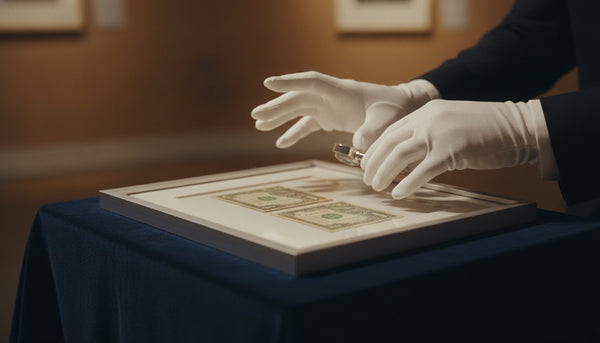
Hand signature and numbering. The artist signs each copy in graphite pencil in the lower-right margin. The edition number — formatted X/100 — appears in the same hand, typically lower-left. Examine the graphite under a loupe: authentic signatures show variable pressure and natural line variation. Printed or photocopied signatures appear uniformly thin and lack depth into the paper surface.
Certificate of Authenticity. A physical COA ships with every edition. At Gauntlet Gallery the standard is gold-embossed — meaning the seal is physically raised from the paper surface, not merely printed in gold ink. Press a fingernail lightly across the embossed area: you should feel distinct ridges. A flat gold-printed seal is a red flag. The COA references the edition number, title, and artist and should match the number on the print itself.
Edition size. Death NYC typically limits portrait series to 50–100 copies. This print runs to 100. Anything purporting to be a lower number from a separate “special edition” of the same image warrants additional documentation.
Print quality. Archival pigment inks on acid-free stock. The polka dots should resolve sharply at the edge with no halftone dot pattern visible to the naked eye. Hold the print at an oblique angle to light: the surface should show even, matte absorption with no streaking or banding.
Retail price anchor. This edition retails at $100, which situates it squarely in Death NYC’s accessible-collectible tier — the same price band where early-market buyers have historically captured the most upside before a motif crosses over to auction.
Collector Value
Death NYC operates in the sweet spot where street credibility and institutional validation have not yet fully converged — which is precisely where secondary-market appreciation tends to be fastest. Popular motifs from the artist’s portrait and pop-collision series have achieved 2x to 5x returns within 12 to 24 months of initial release, driven by a combination of limited supply, growing institutional recognition of street-art printmaking as a legitimate collecting category, and the viral economy of social discovery.
Several factors make the Girl Portrait Red Bow Polka Dots motif particularly well-positioned. First, the Murakami reference: Takashi’s market has remained structurally strong across economic cycles, and works that riff on his visual language benefit from adjacency to one of the most liquid artist markets in contemporary art. Second, the portrait format: Death NYC portrait editions have historically traded at a premium to the artist’s collage-format works because they reproduce more legibly in the square-crop social-media context where secondary sales are increasingly discovered and negotiated.
Gauntlet Gallery has catalogued more than 160,000 comparable sales across the limited-edition print market. The data consistently shows that hand-signed, numbered editions with physical COA in the sub-$500 retail tier outperform their open-edition counterparts on a percentage-return basis, particularly when the edition size is 100 or below and the artist is in an active, pre-peak recognition phase.
Founded in 2012, Gauntlet Gallery has tracked Death NYC from early secondary-market interest through the current period of accelerating collector demand. The position is clear: this is a motif, an artist, and a price point where the risk-reward for a first-time or seasoned print collector is unusually favorable.
Browse current Death NYC inventory and authenticated street-art editions at gauntlet.gallery/collections/all.